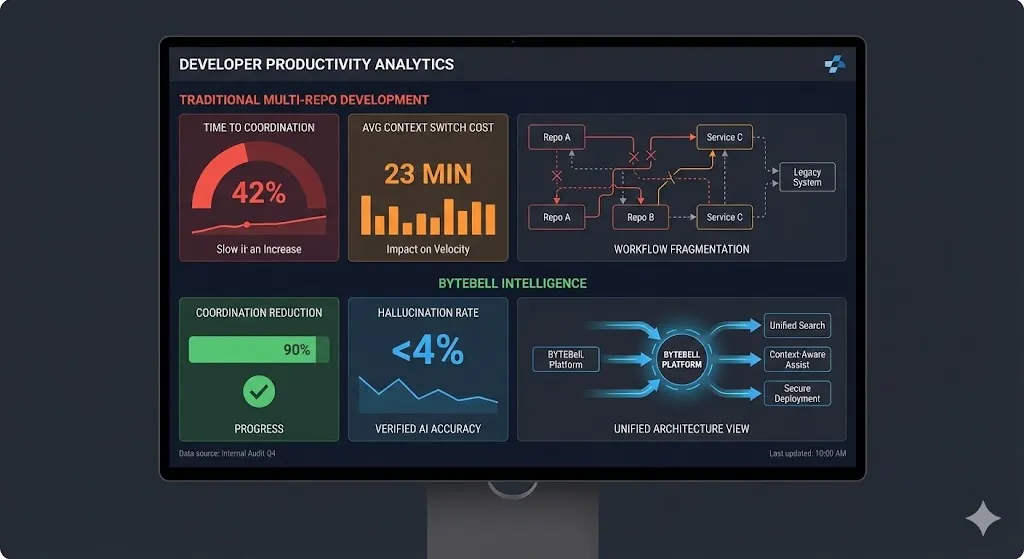
The $85,000 Per Engineer Problem
Your senior developers aren’t slow. Your architecture isn’t broken. The problem is simple: your tools only see one repository at a time, but your enterprise spans 20+.
According to Stripe’s 2024 Developer Report, engineering teams lose 42% of their time to organizational overhead once they pass 50 developers. That’s $85,000 per engineer annually—not building features, but coordinating changes across scattered repositories.
The culprit? Single-repo tools trying to solve multi-repo problems.
The Coordination Crisis: Why Enterprise Teams Are Drowning
Let’s be honest about what happens when you try to update a shared library across your microservices architecture:
Day 1: You discover the library needs a breaking change
Days 2-3: You identify which of your 30+ repositories depend on it
Days 4-10: You manually update each affected service
Days 11-15: You fix the integration tests that broke
Days 16-20: You coordinate deployments so nothing catches fire
One library update. Three weeks. And that’s if you’re lucky.
The Real Cost of Context Switching
Dr. Gloria Mark’s research shows that every “quick” Slack message costs 23 minutes of productive work. When your payment validation logic spans three microservices, and your senior engineers spend 80% of their time context switching between repositories, that’s not a productivity problem—it’s an architecture intelligence problem.
Your team doesn’t need faster autocomplete. They need AI that understands your entire architecture.
Why Your Current Tools Fall Short
GitHub Copilot: Brilliant at One File, Blind to Everything Else
What they promise: AI-powered code completion that makes you 55% more productive
The reality: Copilot only sees what’s currently open in your editor. When ServiceA.ts calls an API in ServiceB.ts that validates against a schema in ServiceC.ts, Copilot has no idea they’re connected.
The breaking point:
- No cross-repository context
- Rate limits frustrate enterprise developers
- Suggestions lack architectural understanding
- Can’t coordinate changes across services
When it works: Writing isolated functions
When it fails: Updating dependencies, refactoring APIs, maintaining architectural consistency
Developer quote from our research: “PRs that used to be 200 lines of clean logic are now 700 lines of Copilot fan fiction that needs extensive debugging.”
Cursor/Windsurf: Better Context, Still Limited Scope
What they promise: Extended context windows for smarter suggestions
The reality: You still have to manually tag every relevant file. When your change touches 9+ repositories, you’re back to context switching hell.
The breaking point:
❌ Manual context tagging across repos
❌ Token limits restrict true multi-repo understanding
❌ No automated dependency awareness
❌ Can’t answer “what breaks if I change this?”
** When it works:** Refactoring within a single repository
** When it fails:** Understanding how changes propagate across your architecture
Sourcegraph: Excellent Search, No Generation
** What they promise:** Code search across your entire codebase
** The reality:** Finding code is step one. You still need to manually generate, test, and coordinate changes across repositories.
** The breaking point :**
❌ Search-only—no code generation
❌ No coordinated multi-repo changes
❌ Can’t auto-update documentation
❌ Doesn’t prevent cross-service failures
** When it works:** Finding where a function is called
** When it fails:** Actually fixing what you found across 20+ services
Augment Code: Multi-Repo, But No Receipts
** When they promise :** AI that indexes 500K+ files across repositories
** The reality:** Suggestions without provenance. No way to verify where recommendations come from.
** The breaking point: **
❌ No source citations or commit hashes
❌ “Trust me” suggestions enterprises can’t audit.
❌ Hallucination risk without verification
❌ Compliance nightmares for regulated industries
** When it works:** Exploratory development
** When it fails :** Production changes that require audit trails
ChatGPT/Claude: Smart Generalists, Codebase Strangers
** When they promise :** General-purpose AI for any task
** The reality:** Zero understanding of your specific architecture, naming conventions, or internal APIs.
** The breaking point: **
❌ No codebase context at all
❌ Confidently hallucinates API endpoints
❌ Can’t cite actual code
❌ Requires copying-and-pasting context for every question
** When it works:** Generic programming questions
** When it fails :** “How do we handle authentication in our payment service?”
Why ByteBell Solves What They Can’t
ByteBell isn’t another autocomplete tool or search engine. It’s the
** The Bytebell difference :** Three Capabilities Competitors Can’t Match
** 1. True Multi-Repo Understanding ** (Up to 50 Repositories Simultaneously) Unlike tools that only see open files or require manual tagging, ByteBell builds a version-aware knowledge graph
** What this means in practise :**
✅ Asks about authentication? ByteBell knows it’s handled in
✅ Update a library? ByteBell identifies every affected service automatically
✅ Add a new API endpoint? ByteBell shows which docs, tests, and dependent services need updates
** Competetive Gap :** GitHub Copilot sees one file. Cursor requires manual tagging. ByteBell sees your entire system.
** 2. Coordinated Code Changes Across Repositories:**
This is where ByteBell eliminates weeks of coordination overhead.
Example: Breaking Change in Shared Library
** With github Copilot :**
- Update library in Repo A
- Manually identify 15 dependent repos
- Update each repo one at a time
- Hope you didn’t miss any
** Timeline :** 2-3 weeks
** With Bytebell :**
- Ask: “Update our auth library to v2.0 and fix all breaking changes”
- ByteBell identifies affected repos and generates coordinated PRs Review, test, and deploy
** Timeline :** 2-3 hours
** Why this matters :** When Allegro manages 2000+ services, manual migration is “incredibly painful.” ByteBell automates what enterprises currently do by hand.
** 3. The Receipts Guarantee: Every Answer Cited to Exact File, Line, and Commit Hash::**
Bytebell refuses to answer without proof. Not “probable” suggestions-verifiable code intelligence.
What you get with every response:
- ✅ Exact file path
- ✅ Line number
- ✅ Commit hash
- ✅ Repository name
- ✅ Version information
Why competitors can’t do this:
ChatGPT/Claude: No codebase access Copilot: Probabilistic generation without source tracking Augment: Multi-repo but no provenance
For enterprises: Hallucination rate: The Architecture Moat: Why ByteBell’s Approach Is Different Built on Version-Aware Knowledge Graphs, Not Just RAG Most AI tools treat your code like a document database. ByteBell understands it as a living, interconnected system. What this enables:
Competitive advantage: Integrates Where You Already Work (MCP + Web + Desktop) ByteBell doesn’t ask you to change your workflow. It meets you where you are. Access methods:
Why MCP matters: Think of it like USB-C for AI tools: Real-World Use Cases: Where ByteBell Dominates Use Case 1: The Breaking Change Nightmare Scenario: GitHub Copilot/Cursor:
Manually update each service Hope your grep caught every reference Fix integration tests that break mysteriously Timeline: 2-3 weeks
ByteBell:
“Update auth library to v3.0 and migrate all services” ByteBell generates coordinated PRs across all affected repos Reviews suggested changes with receipts Timeline: 2-3 hours
ROI: Use Case 2: The “New Developer Lost in the Codebase” Problem Scenario: Sourcegraph:
Search reveals 47 files mention “payment validation” Developer spends days clicking through results Still doesn’t understand the full flow
ByteBell:
“Explain our payment validation flow from checkout to confirmation” ByteBell traces the path across services with exact file citations New developer understands in 20 minutes vs. 2 weeks
ROI: Use Case 3: The “Senior Architect Just Quit” Crisis Scenario: ChatGPT/Generic AI:
Has no knowledge of your codebase Hallucinates reasonable-sounding answers Team implements changes based on guesses
ByteBell:
“Why did we implement rate limiting in the API gateway instead of individual services?” Cites specific commit messages, design docs, and implementation details Institutional knowledge preserved with receipts
ROI: The Compliance Advantage: Why Regulated Industries Choose ByteBell For companies in finance, healthcare, or government, hallucinations aren’t just annoying—they’re deal-breakers. Air Gap Deployment (Coming Soon) The problem: Deployment options:
Enterprise Security Built-In
✅ Zero data retention policy ✅ SOC 2 compliance (coming soon) ✅ HIPAA ready (coming soon) ✅ OAuth 2.1, audit logging, granular access control
Why this matters: The Market Timing Advantage: Why Now Is ByteBell’s Moment
- AI Models Are Commoditizing—Context Is the Moat Anthropic, OpenAI, and Google all offer powerful models. The differentiator isn’t the model—it’s understanding ByteBell’s moat isn’t GPT-4 vs. Claude. It’s the version-aware knowledge graph of
- MCP Protocol: The Right Standard at the Right Time Model Context Protocol is becoming the industry standard for AI integration (like USB-C for AI tools). ByteBell’s advantage:
✅ First mover in enterprise cross-repo MCP servers ✅ Compatible with growing MCP ecosystem (100+ integrations) ✅ No proprietary lock-in—open standards
Competitive lag: 3. Enterprises Hit the “Microservices Coordination Wall” The pattern:
10-30 developers: Monolith works fine 50-100 developers: Microservices enable scaling 100-200+ developers: Coordination overhead cripples velocity
ByteBell solves the coordination crisis that emerges at 100+ engineers, 20+ repositories. Market insight: What Customers Actually Say dxAI “What took hours digging through PDFs now takes seconds.” SEI “The contextual awareness is incredible. ByteBell understands our codebase and documentation better than most other tools.” From Reddit Discussions (Real Developer Feedback): “This is awesome—exactly the kind of tool the ecosystem needs. ByteBell’s verifiable, citation-first approach could massively cut onboarding time and reduce risky guesswork, especially for teams working on privacy layers or confidential runtimes.” “I am very happy to read and learn about your project and I will for sure try it like now and the Eth ecosystem is the best place to learn and build. I like to give you a big Thank you. The less gatekeeping the more the ecosystem grows.” The Bottom Line: What ByteBell Does That Competitors Can’t Final Thought: Single-Repo Tools Can’t Solve Multi-Repo Problems Your enterprise didn’t stay small. Your architecture didn’t stay simple. Why would you expect single-repository tools to keep working? ByteBell isn’t just better at what GitHub Copilot does. It solves the problem they can’t even see. Cross-repository intelligence isn’t a feature request. It’s the next frontier of enterprise development.