TL;DR
Anthropic spent the last 6 months absorbing entire SaaS categories. Cowork wiped $285B from project management and legal tools in 48 hours. Design pushed Figma down another 12%. Managed Agents collapsed valuations across the agent orchestration ecosystem. The pattern is clear and the question every infrastructure startup is asking is the same — will Anthropic build us next.
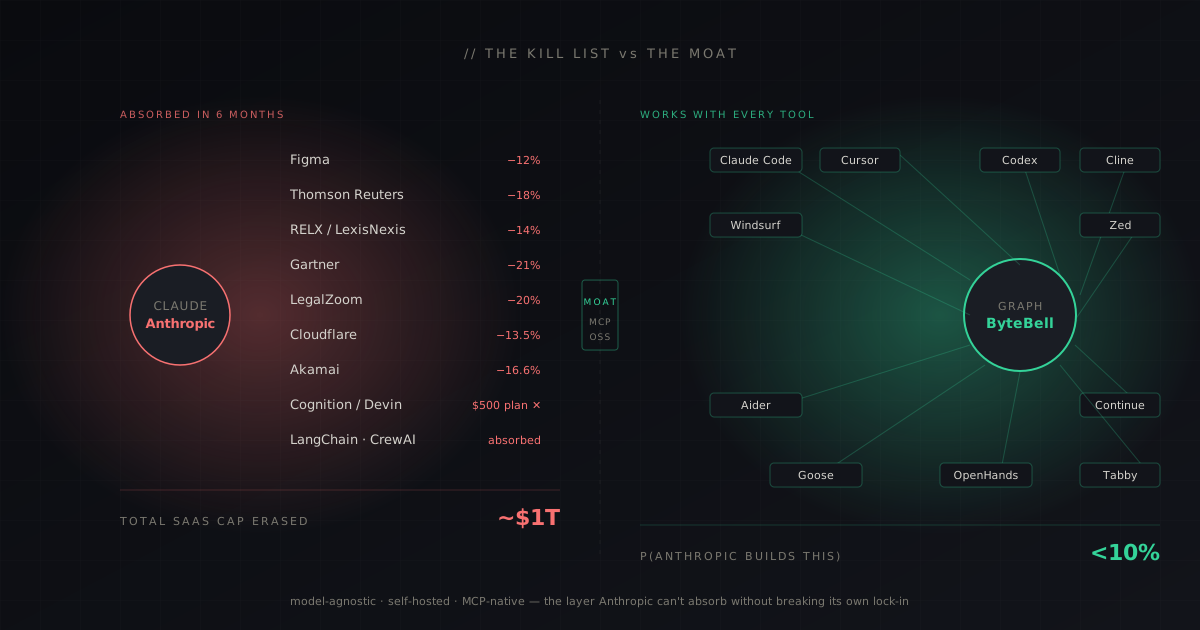
For ByteBell the honest answer is no, and the reason is structural. A persistent, model-agnostic, self-hosted knowledge graph that sits between any codebase and any AI model is the exact opposite of what Anthropic sells. They sell lock-in to Claude. We sell freedom from any single model. They run in the cloud. We run on your laptop or your air-gapped server. The probability Anthropic builds a true ByteBell is under 10%. The probability they ship a Claude-only “good enough” version is real, around 30–40% within 18 months.
Anthropic’s product expansion is a startup kill list
The pattern is so consistent it has a name in our investor decks now — the SaaSpocalypse. Each launch erased a different category of incumbents within days.
Claude Cowork — January 12, 2026
Cowork launched with 11 specialized plugins for legal, finance, sales, HR, and marketing. The market reaction was not subtle.
- Thomson Reuters dropped 18%. LexisNexis parent RELX fell 14%. LegalZoom cratered nearly 20%.
- FactSet and S&P Global saw sharp declines as the market priced in AI-driven research replacing analyst hours.
- Gartner plummeted 21%. Intuit and Equifax each lost more than 10%. Publicis fell 9%. WPP nearly 12%. Omnicom more than 11%.
- Approximately $285B vanished from SaaS valuations within 48 hours.
- By the end of February, roughly $1T in aggregate SaaS market cap had been erased.
Directly threatened — HubSpot, Monday.com, Salesforce, Workday, DocuSign, ServiceNow, Atlassian, LegalZoom, Thomson Reuters, RELX/LexisNexis.
Claude Design — April 17, 2026
Coming for Figma and Canva.
- Figma shares dropped another 5% on launch day, 3 days after Anthropic’s CPO Mike Krieger resigned from Figma’s board.
- Figma’s stock was already down roughly 50% over the past year.
- After Google Stitch 2.0 followed, Figma crashed another 12% in 2 days.
Directly threatened — Figma, Adobe partially, and Canva (which chose to partner rather than fight).
Claude Code — pressuring the entire dev tools category
- IBM suffered its worst single-day loss since October 2000 after Anthropic published a blog post about using Claude Code to modernize COBOL.
- Claude Code already authors 4% of all public GitHub commits.
- Devin killed its $500/month plan under pricing pressure from Claude Code.
Pressured — Devin/Cognition, partially Cursor and Replit, and legacy dev tools companies generally.
Claude Managed Agents — April 8, 2026
The infrastructure layer attack.
- Akamai tumbled 16.6%. Cloudflare dropped 13.5%. DigitalOcean slid 13.4%.
- The agent infrastructure market attracted $2.8B in venture funding in the first half of 2025 alone. Managed Agents now competes with that entire category directly.
Threatened — LangChain, CrewAI, AutoGen, the entire agent orchestration startup ecosystem, plus cloud infrastructure players.
Claude for Healthcare — February 2026
Tools for healthcare providers, payers, and health tech companies with HIPAA-ready products. Threatens health-tech startups building on top of LLMs.
Claude for Financial Services, Legal, Small Business
Each one a specialized bundle that collapses what startups were charging separately for.
Will Anthropic build a ByteBell competitor?
This is the real question and here is the honest assessment.
Arguments that they will
The pattern is clear. Anthropic absorbs any high-value feature into its platform. Cowork ate project management, legal tools, CRM. Design ate prototyping. Managed Agents ate orchestration. Context optimization is a natural next step.
They already have the surface area. Claude Code reads repos. Cowork reads documents. Building a persistent knowledge graph is an engineering project, not a research breakthrough.
Token efficiency directly improves their margins. If users consume 70% fewer tokens, Anthropic’s compute costs drop while subscription revenue stays flat. That is a free margin expansion they would have to actively choose not to capture.
Arguments that they won’t, or can’t easily
ByteBell is model-agnostic. It works with Claude, Cursor, Copilot, Codex, Windsurf, Cline, Aider, Continue, Goose, OpenHands — anything MCP-compatible. Anthropic will never build something model-agnostic. If they build context optimization, it only works with Claude. That is vendor lock-in, not a solution.
ByteBell is self-hosted. Enterprise customers who care about code security — banks, defense, healthcare, anyone with IP that matters — will not send their codebase knowledge graph to Anthropic’s cloud. Anthropic’s business model is cloud-first.
The persistent knowledge graph is a different product category. It is infrastructure that sits between the codebase and any AI tool. Anthropic builds AI tools. They do not build developer infrastructure middleware. The org chart and the GTM motion are not set up for it.
Anthropic is moving up the stack, not down. Cowork, Design, Managed Agents — all higher in the value chain. Their revenue growth (30B annualized in 4 months) comes from enterprise seats, not from developer tooling optimization.
Probability estimate
Roughly 30–40% chance Anthropic ships some form of built-in caching or context optimization for Claude Code specifically, within 12–18 months. But it would be Claude-only, cloud-only, and closed.
A true model-agnostic, self-hosted, MCP-based knowledge graph like ByteBell — under 10% probability. It directly conflicts with their business model of keeping users locked into the Claude ecosystem.
The real risk is not Anthropic building it
The real risk for ByteBell is not Anthropic building a competitor. It is Anthropic shipping a Claude-only version that is “good enough” for teams who only use Claude.
ByteBell’s moat is being the Switzerland of code context — the layer that works everywhere, regardless of which AI vendor is cheapest or best this quarter. Given that pricing changes and rate limits are actively pushing teams toward multi-model strategies (DeepSeek V4 for ingestion, Sonnet 4.6 for premium answers, Claude Code in the IDE, Cursor for refactors), that moat gets stronger, not weaker.
The teams hurt by Anthropic absorbing categories were the ones whose product fit cleanly inside the Claude box. The teams that survive are the ones whose product makes the Claude box less relevant. That is the side of the line ByteBell is built on.
ByteBell is the open source context cache engine for AI coding agents. It brings AI inference costs down by roughly 70% while adding more than 10% accuracy on SOTA models, and it connects to any AI coding agent that speaks MCP. ByteBell is the only context cache that persists across models, sessions, AI copilots, and memory. Free up to 1M tokens and $13 per user per month for 5M tokens.
Repo: github.com/ByteBell/bytebell-oss Website: bytebell.ai