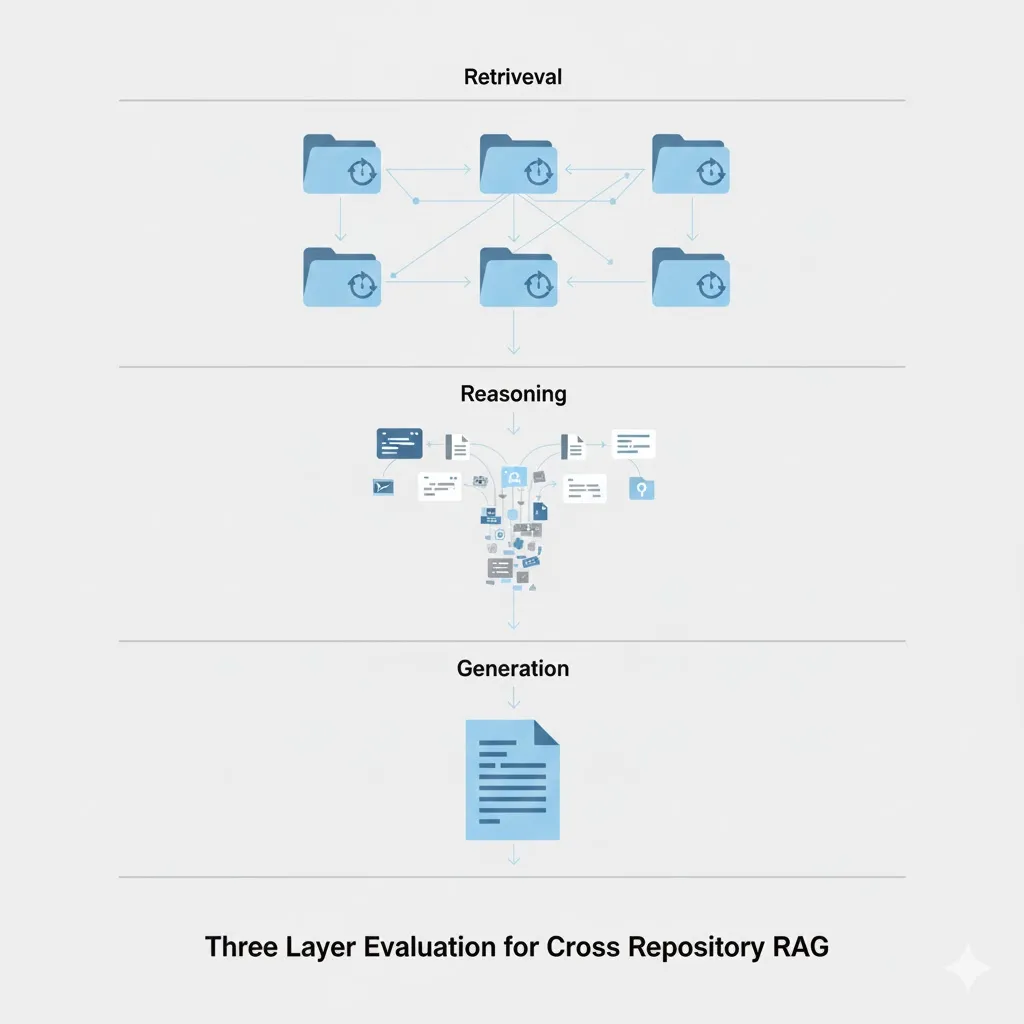
Designing a Three-Layer Evaluation Framework for Cross-Repository GraphRAG
Standard evaluation approaches treat retrieval-augmented generation as a monolithic system: query goes in, answer comes out, measure quality. This works poorly for GraphRAG systems operating across multiple repositories, where failures can occur at distinct stages with very different root causes.
A retrieval failure looks different from a reasoning failure, which looks different from a generation failure. Conflating them makes debugging nearly impossible and optimization directionless.
This post introduces a three-layer evaluation architecture that separates these concerns:
- Retrieval Layer: Can the system find the right files and chunks across repositories?
- Reasoning Layer: Can the system correctly combine information from multiple sources?
- Generation Layer: Is the final output correct and grounded in retrieved context?
Each layer has distinct metrics, target thresholds, and evaluation methodologies. Together, they provide the diagnostic granularity you need to systematically improve a cross-repository GraphRAG system.
Why Three Layers?
Consider a failure case: the system produces an incorrect explanation of your authentication flow. Without layer separation, you face a debugging maze:
- Did retrieval miss the relevant auth service files?
- Did retrieval find them, but reasoning failed to connect frontend and backend components?
- Did reasoning succeed, but generation hallucinated implementation details?
Each root cause requires a different intervention:
| Failure Layer | Symptom | Intervention |
|---|---|---|
| Retrieval | Relevant files never reached the context | Improve embeddings, graph construction, or query expansion |
| Reasoning | Files retrieved but relationships misunderstood | Improve context ordering, add explicit relationship prompts |
| Generation | Context correct but output fabricated details | Adjust generation prompts, add grounding constraints |
A three-layer framework surfaces which layer failed, enabling targeted improvement rather than blind experimentation.
Layer 1: Retrieval Evaluation
What You’re Measuring
Can the GraphRAG system find the correct files and chunks across 25 repositories given a natural language query?
This is the foundation. If retrieval fails, no amount of reasoning or generation sophistication will save you. The system cannot synthesize information it never retrieved.
Core Metrics
| Metric | Definition | Target for Production |
|---|---|---|
| NDCG@k | Normalized discounted cumulative gain at k documents | > 0.75 for k=10 |
| Recall@k | Fraction of relevant documents in top k | > 0.85 for k=20 |
| MRR | Mean reciprocal rank of first relevant document | > 0.6 |
| Cross-Repo Precision | Fraction of retrieved repos that contain relevant docs | > 0.7 |
| Relationship Traversal Accuracy | Did we follow the correct graph edges? | > 0.8 |
NDCG@k captures ranking quality: are the most relevant documents at the top? For cross-repository queries, this matters because context windows are limited—you need the best files first.
Recall@k measures coverage: did we find all the relevant files within the top k? A system with high precision but low recall will miss critical context.
MRR focuses on the first relevant result. For many queries, finding one highly relevant file quickly is more important than perfect ranking of the full list.
Cross-Repo Precision is specific to multi-repository settings. If a query requires files from auth-service and user-frontend, but retrieval returns files from billing-service and analytics, you have a repository-level targeting problem distinct from file-level ranking.
GraphRAG-Specific: Relationship Traversal Accuracy
Standard retrieval metrics assume a flat document collection. Your GraphRAG system uses a knowledge graph, so you need metrics that evaluate graph traversal quality.
Consider a query: “How does user authentication flow from the frontend to the database?”
The correct retrieval path might traverse:
[frontend/auth/LoginForm.tsx]
    --calls--> [backend/api/auth.py]
    --imports--> [backend/services/user_service.py]
    --queries--> [database/schemas/users.sql]
Did your system follow this path, or did it jump to unrelated nodes?
from typing import List, Set, Tuple

def graph_traversal_precision(
    retrieved_paths: List[List[str]],  # Paths through the graph
    gold_paths: List[List[str]]        # Annotated correct paths
) -> float:
    """
    Measure whether the system traversed correct relationships.

    Example gold path:
    [user_service/models.py] --imports--> [shared/types.py]
    --defines--> [User type] --referenced_by--> [frontend/api.ts]
    """
    correct_edges = 0
    total_edges = sum(len(p) - 1 for p in gold_paths)

    for gold_path in gold_paths:
        for retrieved_path in retrieved_paths:
            correct_edges += count_matching_edges(gold_path, retrieved_path)

    return correct_edges / total_edges if total_edges > 0 else 0.0


def count_matching_edges(
    gold_path: List[str],
    retrieved_path: List[str]
) -> int:
    """
    Count how many edges in the gold path appear in the retrieved path.

    An edge is a (source, target) pair representing a graph relationship.
    """
    gold_edges: Set[Tuple[str, str]] = set()
    for i in range(len(gold_path) - 1):
        gold_edges.add((gold_path[i], gold_path[i + 1]))

    retrieved_edges: Set[Tuple[str, str]] = set()
    for i in range(len(retrieved_path) - 1):
        retrieved_edges.add((retrieved_path[i], retrieved_path[i + 1]))

    return len(gold_edges.intersection(retrieved_edges))
This metric captures something NDCG cannot: whether the system understands the relationships between code artifacts, not just their individual relevance.
Cross-Repository Retrieval Precision
For multi-repository systems, you also need repository-level metrics:
from typing import Dict, List, Set

def cross_repo_precision(
    retrieved_docs: List[Dict[str, str]],  # Each doc has 'repo' and 'path'
    relevant_repos: Set[str]               # Ground truth relevant repositories
) -> float:
    """
    What fraction of repositories we retrieved from actually contain relevant docs?

    High cross-repo precision means we're targeting the right repositories.
    Low precision means we're pulling from irrelevant codebases.
    """
    retrieved_repos = set(doc['repo'] for doc in retrieved_docs)

    if not retrieved_repos:
        return 0.0

    correct_repos = retrieved_repos.intersection(relevant_repos)
    return len(correct_repos) / len(retrieved_repos)


def cross_repo_recall(
    retrieved_docs: List[Dict[str, str]],
    relevant_repos: Set[str]
) -> float:
    """
    What fraction of relevant repositories did we retrieve from?

    High cross-repo recall means we're not missing entire codebases.
    """
    retrieved_repos = set(doc['repo'] for doc in retrieved_docs)

    if not relevant_repos:
        return 1.0  # No relevant repos means trivially complete

    covered_repos = retrieved_repos.intersection(relevant_repos)
    return len(covered_repos) / len(relevant_repos)
A system might have excellent file-level NDCG within repositories it searches, but if it never searches the right repositories, overall quality collapses.
Layer 2: Reasoning Evaluation
What You’re Measuring
Given retrieved context from multiple repositories, can the system combine information correctly?
Retrieval might succeed—all the right files are in context—but the system still fails to reason across them. This layer evaluates the synthesis capability.
Core Metrics
| Metric | Definition | Target |
|---|---|---|
| Context Coherence Score | Are retrieved chunks from consistent versions/branches? | > 0.9 |
| Information Integration | Does the response synthesize multiple sources? | > 0.7 |
| Conflict Resolution | When sources disagree, is the resolution correct? | > 0.6 |
| Completeness | Are all relevant aspects of the query addressed? | > 0.75 |
Context Coherence Score
Cross-repository systems face a unique challenge: retrieved files might come from incompatible versions. The backend might be from main, the frontend from a feature branch, and the schema from an outdated commit.
from dataclasses import dataclass
from typing import List, Optional
from datetime import datetime

@dataclass
class RetrievedChunk:
    repo: str
    path: str
    commit_sha: str
    branch: str
    timestamp: datetime
    content: str

def context_coherence_score(
    chunks: List[RetrievedChunk],
    compatibility_matrix: dict  # Defines which versions work together
) -> float:
    """
    Measure whether retrieved chunks come from mutually compatible versions.

    A coherent context has all chunks from versions that were
    actually deployed or tested together.
    """
    if len(chunks) <= 1:
        return 1.0

    compatible_pairs = 0
    total_pairs = 0

    for i, chunk_a in enumerate(chunks):
        for chunk_b in chunks[i + 1:]:
            total_pairs += 1
            if are_versions_compatible(chunk_a, chunk_b, compatibility_matrix):
                compatible_pairs += 1

    return compatible_pairs / total_pairs if total_pairs > 0 else 1.0


def are_versions_compatible(
    chunk_a: RetrievedChunk,
    chunk_b: RetrievedChunk,
    compatibility_matrix: dict
) -> bool:
    """
    Check if two chunks come from compatible versions.

    Compatibility can be defined by:
    - Same branch
    - Commits within a time window
    - Explicit compatibility mapping from CI/CD
    """
    # Same repo, same branch is always compatible
    if chunk_a.repo == chunk_b.repo and chunk_a.branch == chunk_b.branch:
        return True

    # Check explicit compatibility matrix
    key = (chunk_a.repo, chunk_a.commit_sha, chunk_b.repo, chunk_b.commit_sha)
    if key in compatibility_matrix:
        return compatibility_matrix[key]

    # Fallback: commits within 24 hours on main branches are likely compatible
    if chunk_a.branch == 'main' and chunk_b.branch == 'main':
        time_diff = abs((chunk_a.timestamp - chunk_b.timestamp).total_seconds())
        return time_diff < 86400  # 24 hours

    return False
Information Integration Assessment
Does the response actually use multiple sources, or does it rely on a single file and ignore the rest?
from typing import List, Set
import re

def information_integration_score(
    response: str,
    retrieved_chunks: List[RetrievedChunk],
    min_sources_expected: int = 3
) -> float:
    """
    Measure whether the response integrates information from multiple sources.

    A well-integrated response should reference or use content from
    multiple retrieved chunks, not just one.
    """
    sources_used: Set[str] = set()

    for chunk in retrieved_chunks:
        # Check if response contains identifiers, function names,
        # or unique strings from this chunk
        chunk_identifiers = extract_identifiers(chunk.content)

        for identifier in chunk_identifiers:
            if identifier in response and len(identifier) > 4:  # Avoid short matches
                sources_used.add(f"{chunk.repo}/{chunk.path}")
                break

    # Score based on how many sources we expected vs. used
    return min(len(sources_used) / min_sources_expected, 1.0)


def extract_identifiers(code: str) -> List[str]:
    """Extract function names, class names, and variable names from code."""
    # Match common identifier patterns
    patterns = [
        r'def (\w+)\s*\(',           # Python functions
        r'class (\w+)',              # Classes
        r'function (\w+)\s*\(',      # JavaScript functions
        r'const (\w+)\s*=',          # JavaScript constants
        r'CREATE TABLE (\w+)',       # SQL tables
    ]

    identifiers = []
    for pattern in patterns:
        identifiers.extend(re.findall(pattern, code))

    return identifiers
Aggregation Challenge Evaluation
The most rigorous test of reasoning is an “aggregation challenge”—a query that requires multiple sources to answer correctly.
Example Query: “Explain the data flow from user registration to first purchase”
Required sources:
- Frontend: registration form component
- Backend: user creation endpoint
- Database: user and order schemas
- Backend: purchase processing service
- Connector: payment gateway integration
Evaluation criteria:
from dataclasses import dataclass
from typing import List, Optional
from enum import Enum

class IntegrationError(Enum):
    INVENTED_STEP = "invented_step"      # Made up intermediate components
    OMITTED_COMPONENT = "omitted"        # Missed a critical piece
    MISATTRIBUTION = "misattribution"    # Assigned functionality to wrong service
    INCORRECT_ORDER = "incorrect_order"  # Steps in wrong sequence

@dataclass
class AggregationEvaluation:
    query: str
    required_components: List[str]
    response: str
    components_addressed: List[str]
    errors: List[IntegrationError]

    @property
    def completeness_score(self) -> float:
        """Fraction of required components addressed."""
        return len(self.components_addressed) / len(self.required_components)

    @property
    def accuracy_score(self) -> float:
        """Penalize for integration errors."""
        error_penalty = len(self.errors) * 0.15
        return max(0.0, 1.0 - error_penalty)

    @property
    def overall_score(self) -> float:
        """Combined reasoning quality score."""
        return (self.completeness_score + self.accuracy_score) / 2


def evaluate_aggregation_challenge(
    response: str,
    required_components: List[str],
    component_descriptions: dict,  # What each component should do
    llm_judge  # LLM for evaluation
) -> AggregationEvaluation:
    """
    Use an LLM judge to evaluate whether the response correctly
    integrates information from all required components.
    """

    evaluation_prompt = f"""
    Evaluate whether this response correctly explains a data flow.

    Required components that MUST be addressed:
    {format_components(required_components, component_descriptions)}

    Response to evaluate:
    {response}

    For each required component:
    1. Is it mentioned or addressed? (yes/no)
    2. Is it attributed to the correct service/file? (yes/no/na)
    3. Is its role in the flow accurate? (yes/no/na)

    Also identify any errors:
    - INVENTED_STEP: The response describes components that don't exist
    - OMITTED_COMPONENT: A required component is missing
    - MISATTRIBUTION: Functionality is assigned to the wrong service
    - INCORRECT_ORDER: The sequence of steps is wrong

    Return structured evaluation.
    """

    # Call LLM judge and parse response
    evaluation = llm_judge.evaluate(evaluation_prompt)
    return parse_aggregation_evaluation(evaluation, required_components)
Layer 3: Generation Evaluation
What You’re Measuring
Is the final output correct and grounded in retrieved context?
Even with perfect retrieval and reasoning, generation can fail:
- The model might hallucinate details not in context
- Code might have syntax errors or logical bugs
- Explanations might be correct but poorly expressed
Core Metrics
| Metric | Definition | Target |
|---|---|---|
| Factual Correctness | Does the code/explanation work? | > 0.85 |
| Groundedness | Is every claim traceable to retrieved context? | > 0.9 |
| Hallucination Rate | Fraction of claims not supported by context | < 0.1 |
| Repository Attribution | Are sources correctly cited? | > 0.95 |
Execution-Based Evaluation for Code
For code generation tasks, the ultimate test is execution. Does the code actually work?
from dataclasses import dataclass
from typing import List, Dict, Any, Optional
from enum import Enum
import subprocess
import tempfile
import os

class ExecutionStatus(Enum):
    SUCCESS = "success"
    SYNTAX_ERROR = "syntax_error"
    RUNTIME_ERROR = "runtime_error"
    TEST_FAILURE = "test_failure"
    TIMEOUT = "timeout"

@dataclass
class TestCase:
    name: str
    inputs: Dict[str, Any]
    expected_output: Any
    timeout_seconds: float = 30.0

@dataclass
class ExecutionResult:
    status: ExecutionStatus
    tests_passed: int
    tests_total: int
    error_message: Optional[str] = None
    execution_time_ms: Optional[float] = None

    @property
    def pass_rate(self) -> float:
        return self.tests_passed / self.tests_total if self.tests_total > 0 else 0.0


def execute_generated_code(
    generated_code: str,
    test_cases: List[TestCase],
    repository_context: Dict[str, str],  # Mock imports from your repos
    language: str = "python"
) -> ExecutionResult:
    """
    Execute generated code with mocked cross-repository dependencies.

    This allows testing code that imports from multiple repositories
    without requiring the full repository setup.
    """

    with tempfile.TemporaryDirectory() as tmpdir:
        # Set up mock modules for cross-repo imports
        setup_mock_imports(tmpdir, repository_context)

        # Write generated code
        code_path = os.path.join(tmpdir, "generated_code.py")
        with open(code_path, "w") as f:
            f.write(generated_code)

        # Write test harness
        test_path = os.path.join(tmpdir, "test_generated.py")
        test_code = generate_test_harness(test_cases)
        with open(test_path, "w") as f:
            f.write(test_code)

        # Execute tests
        try:
            result = subprocess.run(
                ["python", test_path],
                cwd=tmpdir,
                capture_output=True,
                text=True,
                timeout=max(tc.timeout_seconds for tc in test_cases)
            )

            return parse_test_output(result, test_cases)

        except subprocess.TimeoutExpired:
            return ExecutionResult(
                status=ExecutionStatus.TIMEOUT,
                tests_passed=0,
                tests_total=len(test_cases),
                error_message="Execution timed out"
            )
        except Exception as e:
            return ExecutionResult(
                status=ExecutionStatus.RUNTIME_ERROR,
                tests_passed=0,
                tests_total=len(test_cases),
                error_message=str(e)
            )


def setup_mock_imports(tmpdir: str, repository_context: Dict[str, str]):
    """
    Create mock modules that simulate imports from other repositories.

    repository_context maps import paths to mock implementations:
    {
        "auth_service.models": "class User: ...",
        "shared.types": "UserID = str",
        "database.connection": "def get_db(): return MockDB()"
    }
    """
    for import_path, mock_code in repository_context.items():
        # Convert import path to directory structure
        parts = import_path.split(".")
        module_dir = os.path.join(tmpdir, *parts[:-1])
        os.makedirs(module_dir, exist_ok=True)

        # Create __init__.py files
        for i in range(len(parts) - 1):
            init_path = os.path.join(tmpdir, *parts[:i+1], "__init__.py")
            if not os.path.exists(init_path):
                with open(init_path, "w") as f:
                    f.write("")

        # Write mock module
        module_path = os.path.join(module_dir, f"{parts[-1]}.py")
        with open(module_path, "w") as f:
            f.write(mock_code)
Groundedness Evaluation
For explanation tasks, execution isn’t possible. Instead, we measure whether every claim in the response is traceable to retrieved context.
GROUNDEDNESS_RUBRIC = """
Evaluate whether each factual claim in the response is supported by the provided context.

## Instructions

1. Extract all factual claims from the response
   - A claim is any statement that could be true or false
   - Ignore hedged language ("might", "could", "possibly")
   - Include technical details (function names, file paths, behaviors)

2. For each claim, find supporting evidence in the context
   - Search all provided context chunks
   - Note which chunk (if any) supports the claim

3. Rate each claim's support level:
   - DIRECT: Exact or near-exact match in context
   - INFERRED: Logically derivable from context (e.g., "A calls B" + "B returns X" → "A gets X")
   - UNSUPPORTED: No basis in provided context

4. Calculate groundedness score:
   - Score = (DIRECT + INFERRED) / Total Claims
   - A response is grounded if score > 0.9

## Output Format

For each claim:
Claim: [extracted claim] Support: [DIRECT/INFERRED/UNSUPPORTED] Evidence: [quote from context or “none”]
Final Score: [X/Y claims supported] = [percentage]
Grounded: [YES/NO]
"""


from dataclasses import dataclass
from typing import List, Tuple
from enum import Enum

class SupportLevel(Enum):
    DIRECT = "direct"
    INFERRED = "inferred"
    UNSUPPORTED = "unsupported"

@dataclass
class ClaimEvaluation:
    claim: str
    support_level: SupportLevel
    evidence: Optional[str]
    source_chunk: Optional[str]

@dataclass
class GroundednessResult:
    claims: List[ClaimEvaluation]

    @property
    def total_claims(self) -> int:
        return len(self.claims)

    @property
    def supported_claims(self) -> int:
        return sum(
            1 for c in self.claims
            if c.support_level in (SupportLevel.DIRECT, SupportLevel.INFERRED)
        )

    @property
    def groundedness_score(self) -> float:
        if self.total_claims == 0:
            return 1.0
        return self.supported_claims / self.total_claims

    @property
    def hallucination_rate(self) -> float:
        return 1.0 - self.groundedness_score

    @property
    def is_grounded(self) -> bool:
        return self.groundedness_score >= 0.9


def evaluate_groundedness(
    response: str,
    context_chunks: List[RetrievedChunk],
    llm_judge
) -> GroundednessResult:
    """
    Use an LLM judge to evaluate response groundedness.
    """

    context_formatted = "\n\n---\n\n".join([
        f"Source: {chunk.repo}/{chunk.path}\n{chunk.content}"
        for chunk in context_chunks
    ])

    prompt = f"""
    {GROUNDEDNESS_RUBRIC}

    ## Context
    {context_formatted}

    ## Response to Evaluate
    {response}

    ## Evaluation
    """

    evaluation = llm_judge.evaluate(prompt)
    return parse_groundedness_result(evaluation)
Repository Attribution Accuracy
When the system cites sources, are the citations correct?
from typing import List, Dict, Set
import re

@dataclass
class Citation:
    repo: str
    path: str
    claim: str  # What the citation supposedly supports

@dataclass
class AttributionResult:
    total_citations: int
    correct_citations: int
    incorrect_citations: List[Tuple[Citation, str]]  # (citation, error reason)

    @property
    def attribution_accuracy(self) -> float:
        if self.total_citations == 0:
            return 1.0
        return self.correct_citations / self.total_citations


def evaluate_attribution(
    response: str,
    context_chunks: List[RetrievedChunk],
    citation_pattern: str = r'\[([^\]]+)\]'  # e.g., [repo/path/file.py]
) -> AttributionResult:
    """
    Verify that citations in the response point to correct sources.
    """

    # Extract citations from response
    citations = extract_citations(response, citation_pattern)

    # Build index of available context
    context_index: Dict[str, RetrievedChunk] = {}
    for chunk in context_chunks:
        key = f"{chunk.repo}/{chunk.path}"
        context_index[key] = chunk

    correct = 0
    incorrect = []

    for citation in citations:
        citation_key = f"{citation.repo}/{citation.path}"

        if citation_key not in context_index:
            incorrect.append((citation, "Source not in retrieved context"))
            continue

        chunk = context_index[citation_key]
        if not verify_claim_in_chunk(citation.claim, chunk.content):
            incorrect.append((citation, "Claim not supported by cited source"))
            continue

        correct += 1

    return AttributionResult(
        total_citations=len(citations),
        correct_citations=correct,
        incorrect_citations=incorrect
    )
Putting It All Together: The Evaluation Pipeline
Here’s how the three layers combine into a complete evaluation pipeline:
from dataclasses import dataclass
from typing import List, Optional

@dataclass
class LayeredEvaluationResult:
    # Layer 1: Retrieval
    ndcg_at_10: float
    recall_at_20: float
    mrr: float
    cross_repo_precision: float
    graph_traversal_precision: float

    # Layer 2: Reasoning
    context_coherence: float
    information_integration: float
    completeness: float

    # Layer 3: Generation
    factual_correctness: float  # From execution or manual eval
    groundedness: float
    hallucination_rate: float
    attribution_accuracy: float

    @property
    def retrieval_score(self) -> float:
        """Weighted average of retrieval metrics."""
        return (
            0.3 * self.ndcg_at_10 +
            0.25 * self.recall_at_20 +
            0.15 * self.mrr +
            0.15 * self.cross_repo_precision +
            0.15 * self.graph_traversal_precision
        )

    @property
    def reasoning_score(self) -> float:
        """Weighted average of reasoning metrics."""
        return (
            0.4 * self.context_coherence +
            0.35 * self.information_integration +
            0.25 * self.completeness
        )

    @property
    def generation_score(self) -> float:
        """Weighted average of generation metrics."""
        return (
            0.35 * self.factual_correctness +
            0.35 * self.groundedness +
            0.15 * (1 - self.hallucination_rate) +
            0.15 * self.attribution_accuracy
        )

    @property
    def overall_score(self) -> float:
        """
        Overall system quality.

        Note: These are multiplicative because a failure at any layer
        cascades to subsequent layers.
        """
        return (
            self.retrieval_score *
            self.reasoning_score *
            self.generation_score
        )

    def diagnose_failures(self) -> List[str]:
        """Identify which layers need improvement."""
        issues = []

        if self.retrieval_score < 0.7:
            issues.append("RETRIEVAL: Low retrieval quality - check embeddings and graph construction")
            if self.cross_repo_precision < 0.7:
                issues.append("  - Cross-repo targeting is weak")
            if self.graph_traversal_precision < 0.8:
                issues.append("  - Graph edge traversal is missing relationships")

        if self.reasoning_score < 0.7:
            issues.append("REASONING: Poor information synthesis")
            if self.context_coherence < 0.9:
                issues.append("  - Version coherence issues in retrieved context")
            if self.information_integration < 0.7:
                issues.append("  - Not using multiple sources effectively")

        if self.generation_score < 0.8:
            issues.append("GENERATION: Output quality issues")
            if self.hallucination_rate > 0.1:
                issues.append("  - High hallucination rate - add grounding constraints")
            if self.attribution_accuracy < 0.95:
                issues.append("  - Citation accuracy needs improvement")

        return issues


def run_layered_evaluation(
    query: str,
    system_response: str,
    retrieved_chunks: List[RetrievedChunk],
    gold_documents: List[str],
    gold_paths: List[List[str]],
    required_components: List[str],
    test_cases: Optional[List[TestCase]],
    llm_judge
) -> LayeredEvaluationResult:
    """
    Run complete three-layer evaluation on a single query.
    """

    # Layer 1: Retrieval
    retrieved_docs = [f"{c.repo}/{c.path}" for c in retrieved_chunks]
    ndcg = calculate_ndcg(retrieved_docs, gold_documents, k=10)
    recall = calculate_recall(retrieved_docs, gold_documents, k=20)
    mrr = calculate_mrr(retrieved_docs, gold_documents)

    retrieved_paths = extract_paths_from_chunks(retrieved_chunks)
    graph_precision = graph_traversal_precision(retrieved_paths, gold_paths)

    relevant_repos = set(doc.split('/')[0] for doc in gold_documents)
    cross_repo_prec = cross_repo_precision(
        [{'repo': c.repo, 'path': c.path} for c in retrieved_chunks],
        relevant_repos
    )

    # Layer 2: Reasoning
    coherence = context_coherence_score(retrieved_chunks, {})
    integration = information_integration_score(
        system_response,
        retrieved_chunks,
        min_sources_expected=len(required_components)
    )

    aggregation_eval = evaluate_aggregation_challenge(
        system_response,
        required_components,
        {},  # component descriptions
        llm_judge
    )

    # Layer 3: Generation
    groundedness_result = evaluate_groundedness(
        system_response,
        retrieved_chunks,
        llm_judge
    )

    attribution_result = evaluate_attribution(
        system_response,
        retrieved_chunks
    )

    # Execution-based correctness if test cases provided
    if test_cases:
        exec_result = execute_generated_code(
            extract_code_from_response(system_response),
            test_cases,
            {}  # repository context mocks
        )
        factual_correctness = exec_result.pass_rate
    else:
        factual_correctness = aggregation_eval.accuracy_score

    return LayeredEvaluationResult(
        ndcg_at_10=ndcg,
        recall_at_20=recall,
        mrr=mrr,
        cross_repo_precision=cross_repo_prec,
        graph_traversal_precision=graph_precision,
        context_coherence=coherence,
        information_integration=integration,
        completeness=aggregation_eval.completeness_score,
        factual_correctness=factual_correctness,
        groundedness=groundedness_result.groundedness_score,
        hallucination_rate=groundedness_result.hallucination_rate,
        attribution_accuracy=attribution_result.attribution_accuracy
    )
Target Thresholds Summary
| Layer | Metric | Target | Critical Threshold |
|---|---|---|---|
| Retrieval | NDCG@10 | > 0.75 | < 0.5 = severe |
| Recall@20 | > 0.85 | < 0.6 = severe | |
| MRR | > 0.6 | < 0.3 = severe | |
| Cross-Repo Precision | > 0.7 | < 0.5 = severe | |
| Graph Traversal Accuracy | > 0.8 | < 0.5 = severe | |
| Reasoning | Context Coherence | > 0.9 | < 0.7 = severe |
| Information Integration | > 0.7 | < 0.5 = severe | |
| Completeness | > 0.75 | < 0.5 = severe | |
| Generation | Factual Correctness | > 0.85 | < 0.7 = severe |
| Groundedness | > 0.9 | < 0.8 = severe | |
| Hallucination Rate | < 0.1 | > 0.2 = severe | |
| Attribution Accuracy | > 0.95 | < 0.85 = severe |
Key Takeaways
Layer separation enables diagnosis. When quality drops, you can immediately identify whether retrieval, reasoning, or generation is the bottleneck.
GraphRAG needs graph-aware metrics. Standard IR metrics miss relationship traversal quality. Add metrics that evaluate edge-following behavior.
Cross-repository adds unique dimensions. Repository-level precision, version coherence, and multi-source integration don’t exist in single-repo settings.
Multiplicative degradation is real. Poor retrieval doesn’t just hurt retrieval scores—it cascades through reasoning and generation. The overall score reflects this.
Thresholds should trigger alerts. Set up monitoring with critical thresholds. When any layer drops below critical, investigate immediately.
Next Steps
This framework gives you the metrics. The next post will cover how to build the evaluation dataset: constructing gold annotations for cross-repository queries at scale.
References
- Microsoft GraphRAG evaluation approaches
- Ragas framework for RAG assessment
- RagChecker fine-grained diagnostic framework
- CodeRAG-Bench retrieval-generation gap analysis