Small vs. Large Context Windows: What’s the Actual Difference for Users?
The Whiteboard Analogy
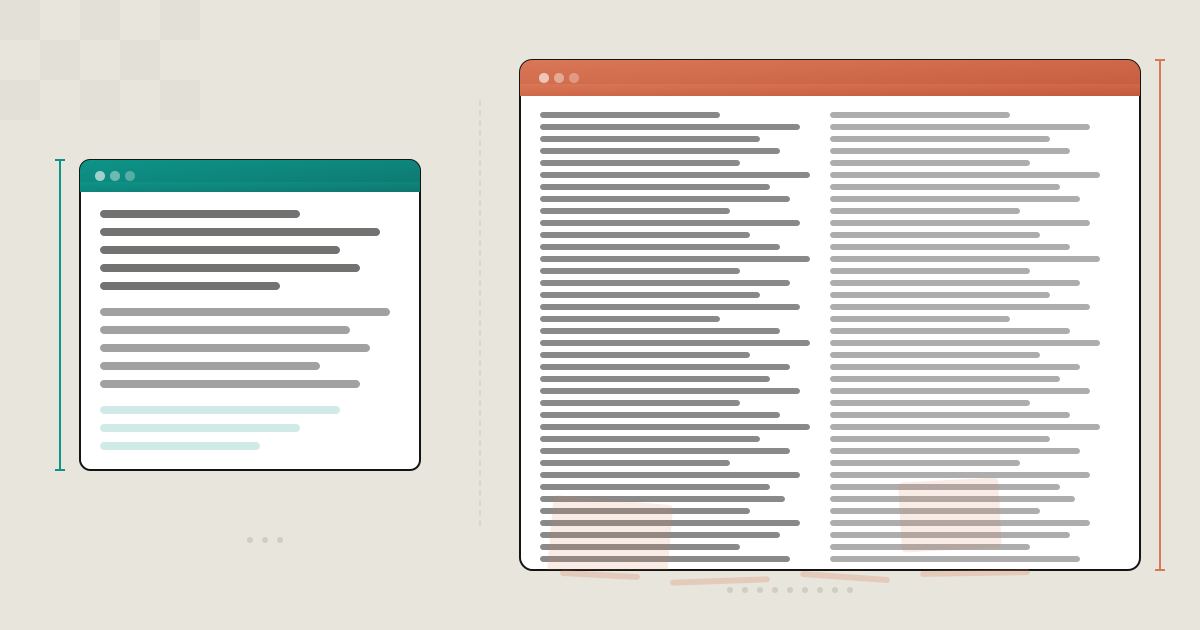
Imagine you’re solving a math problem on a whiteboard. A small whiteboard (4 feet wide) works great for a single equation. A large whiteboard (20 feet wide) can hold an entire proof. But here’s the thing — a bigger whiteboard doesn’t improve your handwriting. If you’re sloppy on a small whiteboard, you’ll be sloppy on a big one too.
The same is true for AI context windows. A bigger context window means the AI can hold more information at once. But it doesn’t automatically mean the AI gives better answers.
Let’s break down what each size actually means for real-world usage.
The Size Tiers
4K Tokens (~3,000 words)
This was standard just two years ago. At 4K tokens, you can fit:
- A short conversation (5–8 turns)
- About 6 pages of text
- One medium-sized function with explanation
Practical limit: You can ask a question, provide a small code snippet, and get an answer. That’s it. No room for long conversations or large documents.
32K Tokens (~24,000 words)
A meaningful upgrade. At 32K tokens:
- A full conversation of 20+ turns
- About 48 pages of text
- A complete short story or a chapter of a book
Practical limit: You can have a decent conversation with some context, but uploading documents quickly fills the window.
128K Tokens (~96,000 words)
This is where things get interesting. 128K tokens is roughly one full novel:
You can fit:
- An entire codebase of a small project
- A full research paper with appendices
- A 50+ turn conversation with document uploads
200K Tokens (~150,000 words)
Two novels. This is Claude’s standard window:
Enough for:
- Multiple related documents
- Long coding sessions
- Detailed multi-file code review
1M Tokens (~750,000 words)
Ten novels. This is frontier territory:
In theory, you can fit:
- An entire medium-sized codebase
- Multiple textbooks
- Hundreds of pages of documentation
10M Tokens (~7.5 million words)
This is theoretical/experimental. Some research models claim this capacity:
The Effective Capacity Problem
Here’s the critical insight: nominal context ≠ effective context.
Research consistently shows that model performance degrades as context fills up. The relationship is approximately:
Where is the efficiency factor:
| Context Size | Typical | Effective Capacity |
|---|---|---|
| 4K | 0.90 | ~3,600 tokens |
| 32K | 0.80 | ~25,600 tokens |
| 128K | 0.70 | ~89,600 tokens |
| 200K | 0.65 | ~130,000 tokens |
| 1M | 0.50–0.60 | ~500,000–600,000 tokens |
The larger the context window, the lower the efficiency factor. This is because of attention dilution — the model’s attention is a finite resource that gets spread thinner as context grows.
The Math of Attention Dilution
In a transformer model, attention is computed via softmax, which normalizes scores to sum to 1:
As (total tokens) grows, the denominator grows, and each individual shrinks. Even for the most relevant token, its attention weight decreases:
This is a mathematical inevitability, not a design flaw.
What Tasks Each Size Enables
Here’s a practical comparison:
# Context window task calculator
def what_fits(context_size: int) -> dict:
    """Estimate what fits in a given context window."""
    tokens = context_size
    effective = int(tokens * 0.7)  # Conservative efficiency

    return {
        "total_tokens": tokens,
        "effective_tokens": effective,
        "pages_of_text": effective // 500,
        "lines_of_code": effective // 10,
        "conversation_turns": effective // 2000,
        "pdf_pages": effective // 600,
    }

for size in [4_000, 32_000, 128_000, 200_000, 1_000_000]:
    info = what_fits(size)
    print(f"\n=== {size:,} Token Window ===")
    for key, val in info.items():
        print(f"  {key}: {val:,}")
Output:
=== 4,000 Token Window ===
  total_tokens: 4,000
  effective_tokens: 2,800
  pages_of_text: 5
  lines_of_code: 280
  conversation_turns: 1
  pdf_pages: 4

=== 32,000 Token Window ===
  total_tokens: 32,000
  effective_tokens: 22,400
  pages_of_text: 44
  lines_of_code: 2,240
  conversation_turns: 11
  pdf_pages: 37

=== 128,000 Token Window ===
  total_tokens: 128,000
  effective_tokens: 89,600
  pages_of_text: 179
  lines_of_code: 8,960
  conversation_turns: 44
  pdf_pages: 149

=== 200,000 Token Window ===
  total_tokens: 200,000
  effective_tokens: 140,000
  pages_of_text: 280
  lines_of_code: 14,000
  conversation_turns: 70
  pdf_pages: 233

=== 1,000,000 Token Window ===
  total_tokens: 1,000,000
  effective_tokens: 700,000
  pages_of_text: 1,400
  lines_of_code: 70,000
  conversation_turns: 350
  pdf_pages: 1,166
The Speed-Size Tradeoff
Bigger context windows are slower. The time to process your request scales linearly with context length for the prefill phase:
And the compute cost scales quadratically for attention:
Here’s what this means in practice:
| Context Used | Relative TTFT | Relative Cost |
|---|---|---|
| 1K tokens | 1× (baseline) | 1× |
| 10K tokens | ~10× | ~100× |
| 100K tokens | ~100× | ~10,000× |
| 1M tokens | ~1,000× | ~1,000,000× |
A query using 1M tokens of context takes roughly 1,000× longer to start generating than a query using 1K tokens.
The Cost Comparison
Let’s do the actual math for API pricing. Using Claude Sonnet at $3/M input tokens:
| Context Used | Cost per Query |
|---|---|
| 4K tokens | $0.012 |
| 32K tokens | $0.096 |
| 128K tokens | $0.384 |
| 200K tokens | $0.600 |
| 1M tokens | $3.000 |
A 1M-token query costs 250× more than a 4K-token query. And in a multi-turn conversation, input tokens accumulate, making subsequent turns even more expensive.
When Bigger Is Better (And When It Isn’t)
Bigger IS better for:
- Long document analysis — Analyzing a full legal contract, research paper, or codebase
- Multi-file code review — Looking at multiple related files simultaneously
- Conversation with lots of context — When you need the AI to remember a complex setup
- Summarization — Condensing a long document into key points
Bigger is NOT better for:
- Simple questions — “What’s the syntax for a Python list comprehension?” doesn’t need 1M tokens
- Quick code generation — Writing a function from a description
- Multiple independent tasks — Better to use separate small-context calls
- Cost-sensitive applications — When you’re paying per token at scale
The Right Strategy: Match Context to Task
def choose_context_strategy(task_type: str, content_size: int) -> str:
    """Recommend a context strategy based on task and content size."""

    if content_size < 4_000:
        return "Direct: fits in any model's context"

    elif content_size < 32_000:
        return "Standard: use 32K-128K model, no special handling needed"

    elif content_size < 128_000:
        return "Large: use 128K+ model, consider chunking for better quality"

    elif content_size < 500_000:
        return "RAG recommended: retrieve relevant chunks instead of stuffing everything"

    else:
        return "RAG required: too much content for effective single-context processing"
The Bottom Line
Context window sizes are like engine sizes in cars. A bigger engine (context window) lets you carry more cargo (information) — but it uses more fuel (compute/money), takes longer to accelerate (time to first token), and doesn’t help if you’re just driving to the grocery store (simple questions).
The art isn’t in having the biggest context window. It’s in putting the right information in the context window.
ByteBell helps engineering teams solve exactly this problem. Instead of stuffing everything into the context window, ByteBell’s Private Code Context retrieves only what matters — keeping your AI sharp, fast, and accurate. Learn more at bytebell.ai