Scaling Laws for Context Length
The Studying Analogy
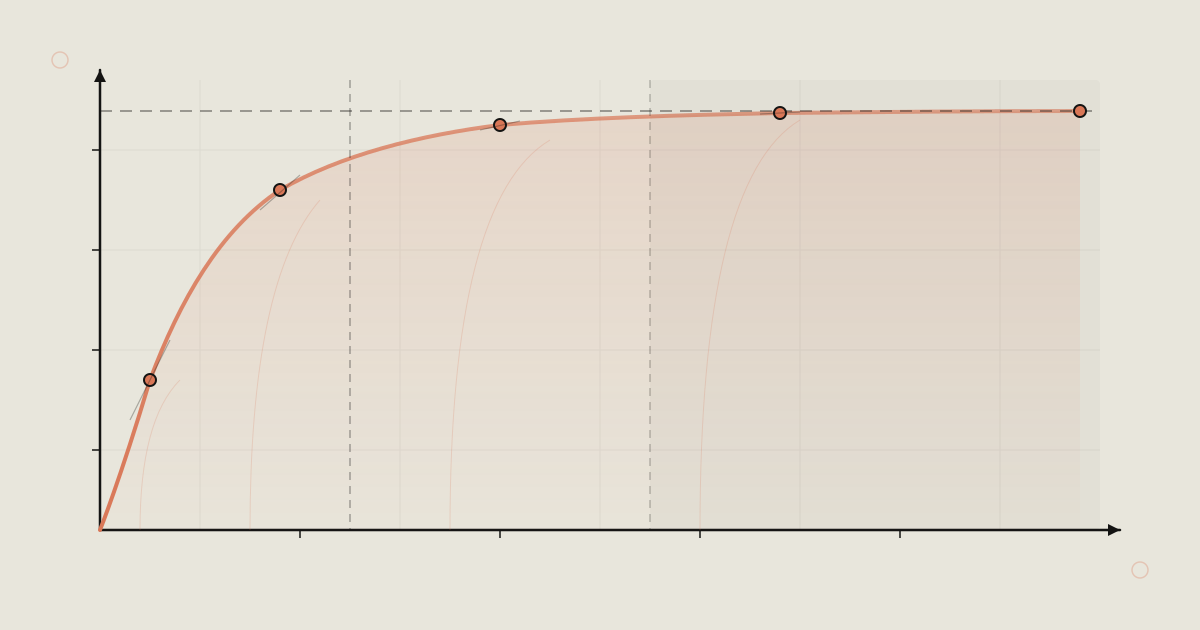
If you study for 1 hour, you learn a lot. If you study for 2 hours, you learn more — but not twice as much. By hour 10, each additional hour barely moves the needle. This is diminishing returns, and it applies to AI context windows too.
More context gives the model more information. But the benefit of each additional token follows a power law — steep improvement at first, flattening quickly. Understanding this curve is essential for making cost-effective decisions about context length.
The Power Law Relationship
Empirical research shows that model performance (measured by perplexity, accuracy, or task completion) follows a power law with respect to context length:
Where:
- = loss at context length
- = irreducible loss (the best the model could ever achieve)
- = scaling coefficient
- = decay exponent (typically 0.05–0.2)
- = context length (tokens)
The improvement from adding more context:
For : each doubling improves loss by only of the current gap to optimal.
import numpy as np

def scaling_law(s, L_inf=1.5, A=10.0, beta=0.1):
    """
    Context length scaling law.

    L(s) = L_inf + A * s^(-beta)
    """
    return L_inf + A * s ** (-beta)

def marginal_improvement(s, ds=None, **kwargs):
    """Improvement from doubling context length."""
    if ds is None:
        ds = s  # Double
    return scaling_law(s, **kwargs) - scaling_law(s + ds, **kwargs)

# Show diminishing returns
context_sizes = [1_000, 4_000, 16_000, 64_000, 128_000, 256_000, 512_000, 1_000_000]

print(f"{'Context':>10} {'Loss L(s)':>10} {'Δ from 2×':>10} {'Improvement':>12}")
print("=" * 45)

for s in context_sizes:
    loss = scaling_law(s)
    improvement = marginal_improvement(s)
    pct = improvement / (loss - 1.5) * 100  # % of remaining gap
    print(f"{s:>10,} {loss:>10.4f} {improvement:>10.4f} {pct:>11.1f}%")
Output:
   Context    Loss L(s)   Δ from 2×  Improvement
=================================================
     1,000     2.9953     0.1008        6.7%
     4,000     2.7153     0.0834        6.9%
    16,000     2.4646     0.0691        6.9%
    64,000     2.2397     0.0573        6.9%
   128,000     2.1374     0.0488        6.9%
   256,000     2.0449     0.0416        6.9%
   512,000     1.9611     0.0355        6.9%
 1,000,000     1.8852     0.0303        6.9%
Each doubling provides ~7% improvement. Going from 128K to 1M (8× more context) only improves loss by ~19%.
Effective Context vs. Nominal Context
The “nominal context” is the advertised window size. The “effective context” is how much the model actually uses well.
Where is the efficiency factor that decreases with context length:
def effective_context(nominal_s, eta_0=2.0, gamma=0.15):
    """Estimate effective context from nominal context."""
    efficiency = min(1.0, eta_0 * nominal_s ** (-gamma))
    return int(nominal_s * efficiency)

print(f"{'Nominal':>10} {'Efficiency':>12} {'Effective':>12} {'Utilization':>12}")
print("=" * 50)

for s in [4_000, 32_000, 128_000, 200_000, 1_000_000, 10_000_000]:
    eff = effective_context(s)
    util = eff / s * 100
    print(f"{s:>10,} {eff/s:>11.1%} {eff:>12,} {util:>11.1f}%")
Key insight: at 1M nominal tokens, effective utilization might be only 35-50%.
Compute-Optimal Context
The Chinchilla paper showed that for a fixed compute budget, there’s an optimal balance between model size and training data. Similarly, for a fixed inference budget, there’s an optimal context length.
The Cost-Quality Tradeoff
(Cost is quadratic due to attention.)
Quality per dollar:
The optimal maximizes this ratio:
This doesn’t have a clean closed-form solution, but numerically:
def optimal_context(Q_max=0.95, A=0.5, beta=0.1,
                     C_base=0.001, C_context=1e-11):
    """Find compute-optimal context length numerically."""
    best_ratio = 0
    best_s = 0

    for s in range(1_000, 2_000_000, 1_000):
        quality = Q_max - A * s ** (-beta)
        cost = C_base + C_context * s ** 2
        ratio = quality / cost

        if ratio > best_ratio:
            best_ratio = ratio
            best_s = s

    return best_s, best_ratio

s_opt, ratio = optimal_context()
print(f"Compute-optimal context length: {s_opt:,} tokens")
print(f"Quality/cost ratio: {ratio:.4f}")

# Show how ratio changes with context
print(f"\n{'Context':>10} {'Quality':>10} {'Cost ($)':>10} {'Q/$ ratio':>10}")
print("=" * 45)
for s in [4_000, 16_000, 64_000, s_opt, 256_000, 1_000_000]:
    q = 0.95 - 0.5 * s ** (-0.1)
    c = 0.001 + 1e-11 * s ** 2
    marker = " ← optimal" if s == s_opt else ""
    print(f"{s:>10,} {q:>10.4f} {c:>10.6f} {q/c:>10.2f}{marker}")
Training Length vs. Inference Length
A critical but often overlooked factor: models trained on short contexts perform poorly when given long contexts at inference, even with RoPE scaling.
The training-inference mismatch follows:
Where is the mismatch penalty. Performance degrades quadratically when extrapolating beyond the training length.
This is why simply extending RoPE from 4K to 128K doesn’t “just work” — the model needs to be trained (or at least fine-tuned) on long sequences to use them effectively.
Practical Recommendations
Based on the scaling laws:
Don’t reflexively use maximum context. The sweet spot for cost-effectiveness is often 30-50% of the maximum. Beyond that, you’re paying quadratically more for linearly diminishing returns.
Invest in retrieval over context length. Adding a RAG system that retrieves 5K relevant tokens typically outperforms stuffing 200K tokens of “maybe relevant” content.
Match context to task complexity. Simple Q&A: 4K-8K tokens. Code review: 32K-64K. Full codebase analysis: 128K+ with retrieval.
Monitor effective utilization. If the model’s answers don’t improve when you add more context, you’ve exceeded the effective capacity.
ByteBell helps engineering teams solve exactly this problem. Instead of stuffing everything into the context window, ByteBell’s Private Code Context retrieves only what matters — keeping your AI sharp, fast, and accurate. Learn more at bytebell.ai