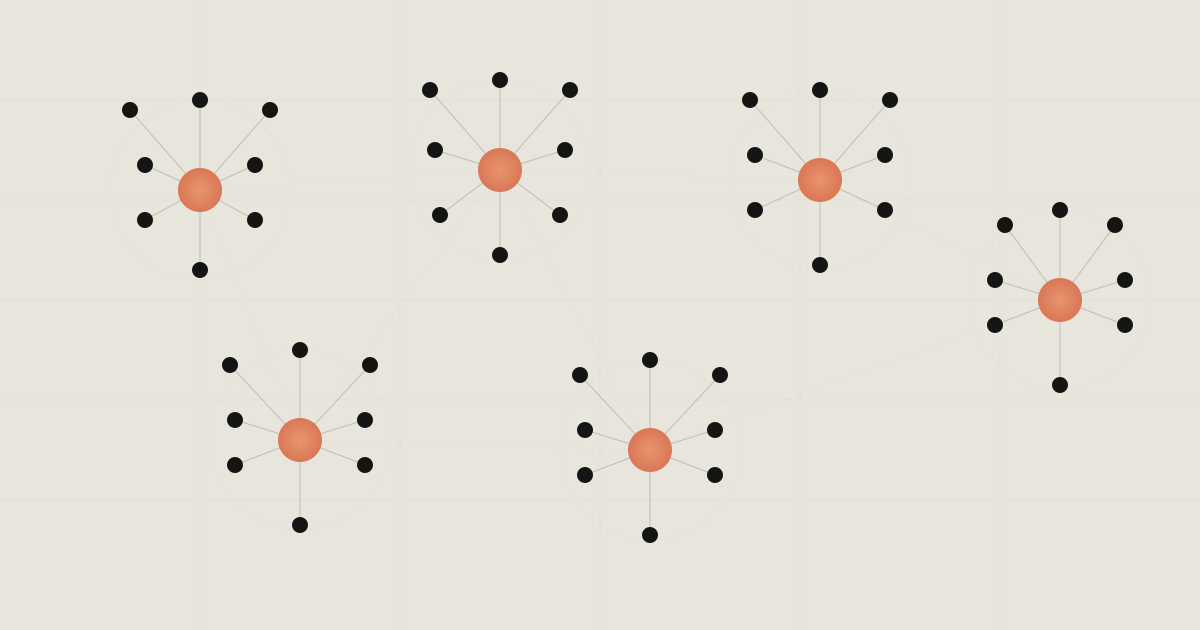
Multi-Query and Grouped-Query Attention
The Shared Textbook Analogy
In a class of 64 students (attention heads), imagine each student needs their own copy of the textbook (KV pair). That’s 64 textbooks. Expensive!
Multi-Query Attention (MQA): All 64 students share ONE textbook. Cheap, but students are often waiting for their turn.
Grouped-Query Attention (GQA): Groups of 8 students share one textbook. 8 textbooks total — much cheaper than 64, and the wait is manageable.
This is exactly how modern LLMs reduce KV cache memory.
Standard Multi-Head Attention (MHA)
In standard MHA, each head has its own Q, K, V projections:
KV cache per layer: elements.
For a model with heads, , at tokens:
With 80 layers: 335 GB just for KV cache.
Multi-Query Attention (MQA)
MQA (Shazeer, 2019): All heads share a single K and V:
Each head still has its own query, so they “ask different questions.” But they all look at the same keys and values.
Reduction factor:
The Quality Tradeoff
MQA reduces memory by 64× but each head sees the same KV, limiting the diversity of information each head can retrieve. Empirical results show 1-3% quality degradation — small but not zero.
Grouped-Query Attention (GQA)
GQA (Ainslie et al., 2023): A middle ground. Heads are divided into groups, each sharing one KV pair:
With heads and groups: each group has 8 heads sharing one KV.
Reduction factor:
The Sweet Spot
| Method | KV Heads | KV Cache (per layer) | Quality | Reduction |
|---|---|---|---|---|
| MHA | 64 | Baseline | 1× | |
| GQA-8 | 8 | ~99% | 8× | |
| GQA-4 | 4 | ~98% | 16× | |
| GQA-2 | 2 | ~97% | 32× | |
| MQA | 1 | ~97% | 64× |
import numpy as np

def compare_attention_variants(
    n_query_heads: int = 64,
    head_dim: int = 128,
    seq_length: int = 128_000,
    n_layers: int = 80,
    precision_bytes: int = 2,
):
    """Compare MHA, GQA, and MQA KV cache requirements."""

    variants = [
        ("MHA", n_query_heads),
        ("GQA-16", 16),
        ("GQA-8", 8),
        ("GQA-4", 4),
        ("GQA-2", 2),
        ("MQA", 1),
    ]

    print(f"Config: {n_query_heads} Q-heads, d_h={head_dim}, "
          f"seq={seq_length:,}, {n_layers} layers, FP16")
    print()
    print(f"{'Variant':<10} {'KV Heads':>10} {'KV/Layer':>10} "
          f"{'Total KV':>10} {'Reduction':>10}")
    print("=" * 55)

    base_mem = None
    for name, kv_heads in variants:
        per_layer = 2 * kv_heads * head_dim * seq_length * precision_bytes
        total = per_layer * n_layers
        total_gb = total / (1024**3)

        if base_mem is None:
            base_mem = total_gb
        reduction = base_mem / total_gb

        print(f"{name:<10} {kv_heads:>10} {per_layer/(1024**3):>9.1f}G "
              f"{total_gb:>9.1f}G {reduction:>10.0f}×")

compare_attention_variants()
PyTorch Implementation
import torch
import torch.nn as nn
import torch.nn.functional as F

class MultiHeadAttention(nn.Module):
    """Standard Multi-Head Attention (MHA)."""

    def __init__(self, d_model, n_heads):
        super().__init__()
        self.n_heads = n_heads
        self.d_k = d_model // n_heads

        self.W_Q = nn.Linear(d_model, d_model)
        self.W_K = nn.Linear(d_model, d_model)  # Full size
        self.W_V = nn.Linear(d_model, d_model)  # Full size
        self.W_O = nn.Linear(d_model, d_model)

    def forward(self, x):
        B, N, D = x.shape
        Q = self.W_Q(x).view(B, N, self.n_heads, self.d_k).transpose(1, 2)
        K = self.W_K(x).view(B, N, self.n_heads, self.d_k).transpose(1, 2)
        V = self.W_V(x).view(B, N, self.n_heads, self.d_k).transpose(1, 2)

        attn = F.scaled_dot_product_attention(Q, K, V)
        return self.W_O(attn.transpose(1, 2).reshape(B, N, D))


class GroupedQueryAttention(nn.Module):
    """Grouped-Query Attention (GQA)."""

    def __init__(self, d_model, n_heads, n_kv_heads):
        super().__init__()
        self.n_heads = n_heads
        self.n_kv_heads = n_kv_heads
        self.n_groups = n_heads // n_kv_heads
        self.d_k = d_model // n_heads

        self.W_Q = nn.Linear(d_model, n_heads * self.d_k)
        self.W_K = nn.Linear(d_model, n_kv_heads * self.d_k)  # Smaller!
        self.W_V = nn.Linear(d_model, n_kv_heads * self.d_k)  # Smaller!
        self.W_O = nn.Linear(d_model, d_model)

    def forward(self, x):
        B, N, D = x.shape

        Q = self.W_Q(x).view(B, N, self.n_heads, self.d_k).transpose(1, 2)
        K = self.W_K(x).view(B, N, self.n_kv_heads, self.d_k).transpose(1, 2)
        V = self.W_V(x).view(B, N, self.n_kv_heads, self.d_k).transpose(1, 2)

        # Expand KV heads to match Q heads by repeating
        K = K.repeat_interleave(self.n_groups, dim=1)  # (B, n_heads, N, d_k)
        V = V.repeat_interleave(self.n_groups, dim=1)

        attn = F.scaled_dot_product_attention(Q, K, V)
        return self.W_O(attn.transpose(1, 2).reshape(B, N, D))


class MultiQueryAttention(nn.Module):
    """Multi-Query Attention (MQA) — GQA with 1 KV head."""

    def __init__(self, d_model, n_heads):
        super().__init__()
        self.n_heads = n_heads
        self.d_k = d_model // n_heads

        self.W_Q = nn.Linear(d_model, n_heads * self.d_k)
        self.W_K = nn.Linear(d_model, self.d_k)  # Single head!
        self.W_V = nn.Linear(d_model, self.d_k)  # Single head!
        self.W_O = nn.Linear(d_model, d_model)

    def forward(self, x):
        B, N, D = x.shape

        Q = self.W_Q(x).view(B, N, self.n_heads, self.d_k).transpose(1, 2)
        K = self.W_K(x).view(B, N, 1, self.d_k).transpose(1, 2)
        V = self.W_V(x).view(B, N, 1, self.d_k).transpose(1, 2)

        # Broadcast single KV head to all Q heads
        K = K.expand(-1, self.n_heads, -1, -1)
        V = V.expand(-1, self.n_heads, -1, -1)

        attn = F.scaled_dot_product_attention(Q, K, V)
        return self.W_O(attn.transpose(1, 2).reshape(B, N, D))


# Parameter count comparison
d_model = 8192
n_heads = 64

mha = MultiHeadAttention(d_model, n_heads)
gqa = GroupedQueryAttention(d_model, n_heads, n_kv_heads=8)
mqa = MultiQueryAttention(d_model, n_heads)

for name, module in [("MHA", mha), ("GQA-8", gqa), ("MQA", mqa)]:
    kv_params = sum(p.numel() for n, p in module.named_parameters()
                    if 'W_K' in n or 'W_V' in n)
    total_params = sum(p.numel() for p in module.parameters())
    print(f"{name:<8} KV params: {kv_params:>12,}  Total: {total_params:>12,}")
Why Llama 3 Chose GQA-8
Llama 3 (70B) uses 64 query heads and 8 KV heads (). The reasoning:
- 8× KV cache reduction makes 128K context feasible on 8×H100
- Minimal quality loss (less than 0.5% on benchmarks vs MHA)
- Good throughput - KV computation is 8x cheaper
- Proven at scale - Google’s PaLM 2 validated GQA in production
The math works out perfectly: at 128K context, GQA-8 needs ~39 GB KV cache vs ~312 GB for MHA. That’s the difference between “fits on 8 GPUs” and “impossible.”
ByteBell helps engineering teams solve exactly this problem. Instead of stuffing everything into the context window, ByteBell’s Private Code Context retrieves only what matters — keeping your AI sharp, fast, and accurate. Learn more at bytebell.ai