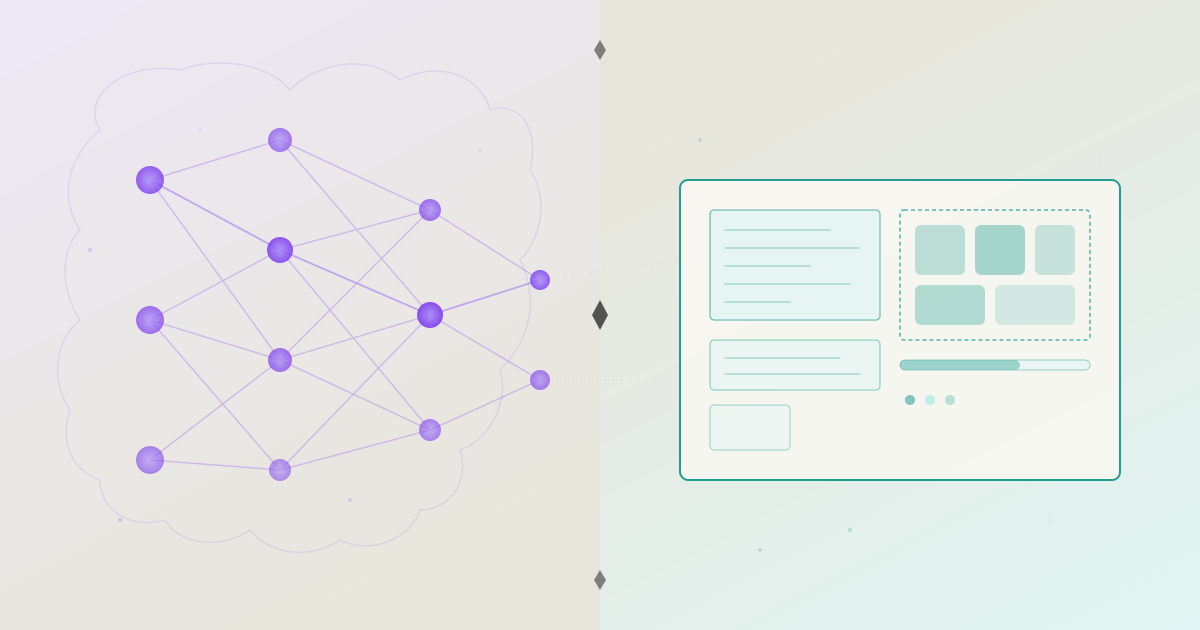
Context Window vs. Training Data: Two Completely Different Things
The Student Analogy
Think of an AI model like a student who has studied for years.
Training data = everything the student studied in school over 12 years. Textbooks, lectures, homework — all absorbed and internalized into “knowledge.”
Context window = the notes the student can look at during an open-book exam. Limited to what fits on their desk right now.
The student “knows” calculus because they studied it (training data). But if you ask them to debug your specific code, they need to see your code (context window). No amount of studying can help with something they’ve never seen.
Parametric vs. Non-Parametric Memory
Computer scientists use precise terms for these two types of knowledge:
Parametric Memory (Model Weights)
This is what the model learned during training, encoded in its billions of parameters (weights):
Where represents all the model’s learned parameters — matrices of floating-point numbers that encode patterns, facts, and capabilities.
Properties:
- Learned during training (takes weeks/months on thousands of GPUs)
- Fixed after training (doesn’t change during inference)
- Compressed representation (trillions of training tokens → billions of parameters)
- Lossy (not everything from training is retained)
Non-Parametric Memory (Context Window)
This is what the model can “see” right now:
Properties:
- Provided at inference time (changes with every request)
- Ephemeral (gone when the request ends)
- Exact (the model sees the actual text, not a compressed version)
- Limited (bounded by context window size )
How They Interact
When the model generates a response, it uses both types of memory:
def model_response(context_window, model_weights):
    """
    Simplified view of how LLMs generate responses.

    The model uses BOTH parametric memory (weights) and
    non-parametric memory (context) to generate output.
    """
    # Step 1: Encode the context using model weights
    # The weights determine HOW to process the context
    encoded = encode(context_window, model_weights)

    # Step 2: Generate output based on both
    # - Weights provide general knowledge ("Python uses 0-indexing")
    # - Context provides specific information ("the user's function is called foo()")
    output = generate(encoded, model_weights)

    return output
Here’s a concrete example:
Question: “What does my calculate_tax() function return for income > $100K?”
The model uses:
- Weights (parametric): Knows Python syntax, how tax brackets work generally, common patterns
- Context (non-parametric): Needs to SEE your
calculate_tax()function to answer specifically
Without the function in the context window, the model can only guess based on common patterns.
The Knowledge Cutoff Problem
Training data has a cutoff date. The model doesn’t know about anything that happened after training ended.
| Model | Knowledge Cutoff |
|---|---|
| GPT-4 | ~April 2024 |
| Claude 3.5 | ~April 2024 |
| Llama 3 | ~March 2024 |
If you ask about an event after the cutoff, the model literally has no parametric knowledge about it. The only way it can answer is if you provide that information in the context window.
# Without context: model uses parametric memory (weights)
prompt_1 = "Who won the 2024 Super Bowl?"
# Model can answer if cutoff is after Feb 2024

# With context: model uses non-parametric memory (context window)
prompt_2 = """
News article: The Kansas City Chiefs won Super Bowl LVIII on
February 11, 2024, defeating the San Francisco 49ers 25-22
in overtime.

Question: Who won the 2024 Super Bowl?
"""
# Model can answer regardless of cutoff date
Why Fine-Tuning Exists
If the context window is limited and training data has a cutoff, how do you teach a model new, specialized knowledge?
Fine-tuning modifies the model’s weights on new data:
This is like sending the student back to school for additional training on a specific subject.
# Conceptual fine-tuning process
def fine_tune(model, new_dataset, learning_rate=1e-5):
    """
    Update model weights on new data.

    This modifies parametric memory to include new knowledge.
    """
    for batch in new_dataset:
        # Forward pass: compute prediction
        prediction = model(batch.input)

        # Compute loss: how wrong was the prediction?
        loss = cross_entropy(prediction, batch.target)

        # Backward pass: compute gradients
        gradients = compute_gradients(loss, model.parameters)

        # Update weights: the model "learns" from this data
        for param, grad in zip(model.parameters, gradients):
            param -= learning_rate * grad

    return model  # Now has new knowledge in its weights
When to fine-tune vs. use context:
| Approach | Use When |
|---|---|
| Context window | Information is specific to this request |
| RAG + context | Information exists in a document store |
| Fine-tuning | The model needs to learn a new behavior or domain permanently |
Why RAG Exists
Retrieval-Augmented Generation (RAG) bridges the gap between parametric and non-parametric memory:
Instead of trying to cram everything into model weights (expensive, slow) or into the context window (limited size), RAG retrieves relevant information and places it in the context window at query time.
def rag_pipeline(user_query, knowledge_base, model):
    """
    RAG: Retrieve relevant info, then generate with context.
    """
    # Step 1: Find relevant documents
    # This uses the knowledge_base (non-parametric, external memory)
    relevant_docs = knowledge_base.search(
        query=user_query,
        top_k=5
    )

    # Step 2: Construct context window
    context = f"""Use the following information to answer the question.

Information:
{format_docs(relevant_docs)}

Question: {user_query}

Answer:"""

    # Step 3: Model uses both weights AND retrieved context
    response = model.generate(context)
    return response
The Compression Ratio
Here’s a mind-blowing number. GPT-4 was reportedly trained on ~13 trillion tokens. Its weights are ~1.8 trillion parameters, stored in ~3.6 TB (FP16).
The compression ratio from training data to weights:
The model compresses 14,000 bytes of training data into every byte of weights. This is enormously lossy — which is why the model “knows” Python in general but can’t remember the exact documentation for a specific library function.
Common Misconceptions
Misconception 1: “The model has access to its training data”
Wrong. The model cannot “look up” its training data. The training data was used to adjust weights, then discarded. It’s like asking a chef to show you the recipe book they learned from 10 years ago — the knowledge is in their hands, not a book.
Misconception 2: “Bigger context window = don’t need training data”
Wrong. Context provides specific, situational information. Weights provide general capabilities. You can’t teach a model to “understand Python” by putting Python tutorials in the context — that’s what pre-training does.
Misconception 3: “The model knows everything it was trained on”
Wrong. Training is lossy compression. The model learned patterns and distributions, not exact facts. It might know that “Paris is the capital of France” (high-frequency pattern) but not “the population of Liechtenstein” (low-frequency fact).
The Formula for Effective AI
The best AI applications combine all three forms of knowledge:
- Weights provide capabilities and general knowledge
- Retrieved context provides specific, up-to-date information
- User input provides the specific question and requirements
The art is in optimizing the retrieved context — giving the model exactly what it needs, nothing more, nothing less.
ByteBell helps engineering teams solve exactly this problem. Instead of stuffing everything into the context window, ByteBell’s Private Code Context retrieves only what matters — keeping your AI sharp, fast, and accurate. Learn more at bytebell.ai