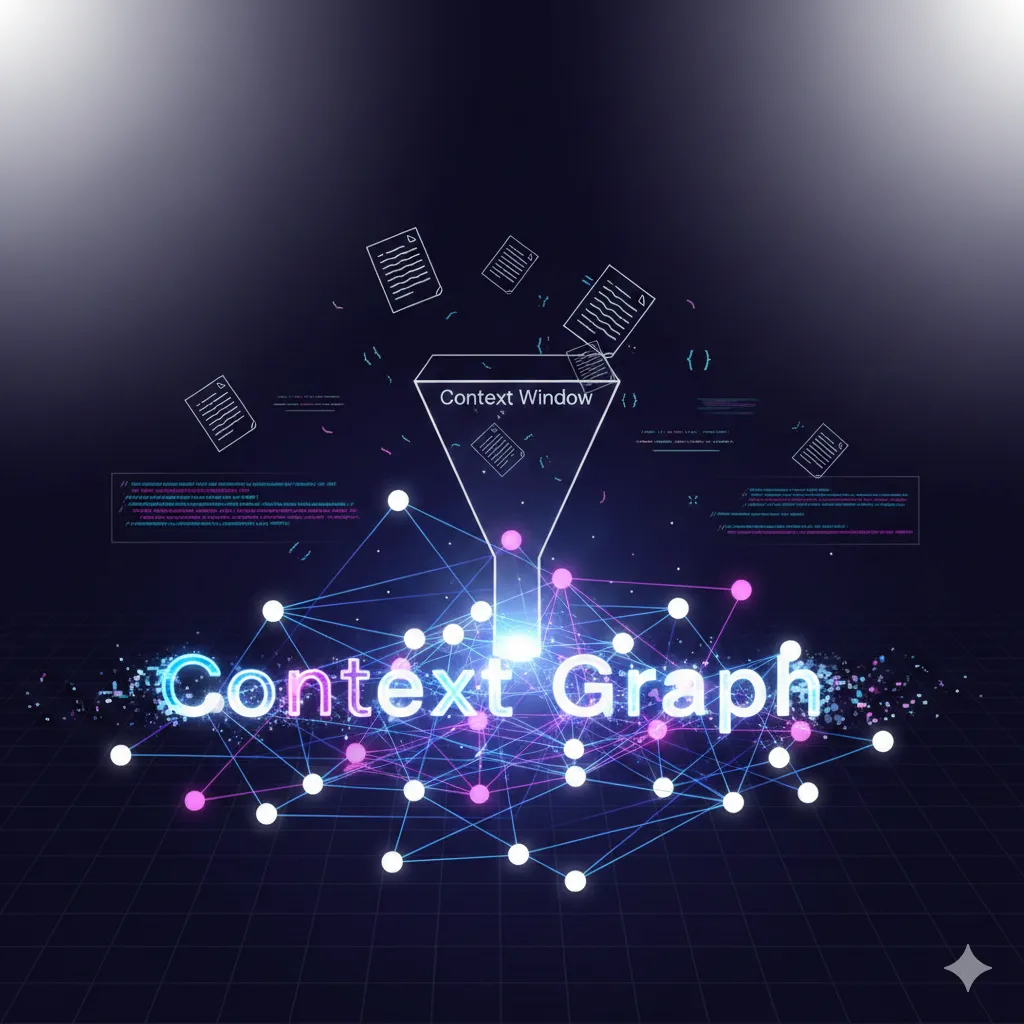
Why “Context Graph” Has Become the Most Misunderstood Term in AI Engineering
A deep dive into context management, prompt engineering, and why every AI tool now claims to solve the “context problem”
You’ve probably heard the term “context graph” thrown around more than a frisbee at a Silicon Valley team building event. Every new AI coding assistant, documentation tool, and repository analyzer claims they’ve solved context management with their proprietary “context graph” technology. But what does this actually mean? And why has this term become so diluted it’s lost most of its technical meaning?
Before we dive into why context management has become such a hot topic (and why the terminology is so abused), we need to understand the fundamental constraints that make context handling the central challenge of modern LLM applications.
How LLMs Actually Generate Text
Most blog posts either oversimplify this to “magic prediction” or drown you in transformer architecture diagrams. You’re an engineer—you can handle the middle ground.
The Token Generation Loop
Large Language Models don’t “think” about your entire response at once. They operate on a simple principle: predict the next token, then predict the next one, then repeat until done.
When you hit “Send” on your prompt:
Tokenization: Your input text gets broken down into tokens (roughly words or word pieces). “Hello world” might become
["Hello", " world"]. More complex text gets more granular—“ChatGPT” might split into["Chat", "G", "PT"].Embedding: Each token gets converted into a high-dimensional vector (think 4096 dimensions for modern models). This vector representation captures semantic meaning in a continuous space.
Attention Mechanism: The model looks at all previous tokens in your context and calculates attention scores. It’s asking: “Given what I’ve seen so far, which previous tokens are most relevant to predicting what comes next?”
Probability Distribution: The model outputs a probability distribution over its entire vocabulary (50,000+ tokens). Maybe “the” has a 15% probability of being next, “a” has 8%, and so on.
Sampling: The system picks the next token (either greedily taking the highest probability, or using sampling strategies like temperature and top-p to add controlled randomness).
Append and Repeat: That chosen token gets added to the context, and the entire process repeats.
Why This Matters for Context
At every single step, the model processes the entire context from the beginning. If you have 10,000 tokens in your context, generating token #10,001 requires the model to attend to all 10,000 previous tokens. Generate token #10,002? Attend to all 10,001 tokens.
This is why LLM generation isn’t just slow—it gets progressively slower with longer contexts.
Why We Can’t Just Have a 10 Million Token Context Window
“Why don’t they just give us bigger context windows?” This question appears in every developer forum, usually from someone frustrated that their entire codebase won’t fit in context. The answer isn’t about artificial limitations or business models—it’s about fundamental computational constraints.
The KV Cache: Your Memory Bottleneck
When an LLM processes tokens, it doesn’t recompute everything from scratch each time (that would be catastrophically slow). Instead, it uses something called the Key-Value (KV) cache.
In the attention mechanism, each token generates three vectors:
- Query (Q): “What am I looking for?”
- Key (K): “What information do I represent?”
- Value (V): “What information do I contain?”
For each new token, the model:
- Computes its Query vector
- Compares it against all previous Keys (this is the “attention” part)
- Uses those attention scores to create a weighted sum of all previous Values
The KV cache stores those K and V vectors for every token in your context. Without it, the model would need to recompute them for every single token generation, making inference impossibly slow.
The Memory Math That Breaks Your Dreams
Let’s do some actual math. For a model like Claude Sonnet or GPT-4:
Per token, per layer:
Key vector: ~4,096 dimensions × 4 bytes (float32) = 16 KB
Value vector: ~4,096 dimensions × 4 bytes = 16 KB
Total per token per layer: 32 KB
For a full model with, say, 50 layers:
Per token: 32 KB × 50 = 1.6 MBFor a 1 million token context:
Total KV cache: 1.6 TB of GPU memoryAnd that’s just for ONE concurrent user. That’s just the KV cache—not the model weights, not the activation memory, not any of the other overhead.
Current top-tier GPUs (like the H100) have 80GB of memory. You’d need 20 H100s just to hold the KV cache for a single million-token context.
Note: This is worst case math for a simple model. Real world models use smart memory tricks to dramatically reduce this cost. The takeaway is not that large context is impossible, but that it requires very advanced engineering to make it practical.
Quadratic Attention Complexity
Even if you solved the memory problem, you’d hit another wall: attention complexity is with respect to context length.
Every new token must attend to every previous token:
- 1,000 tokens: ~1 million attention computations per new token
- 10,000 tokens: ~100 million attention computations per new token
- 100,000 tokens: ~10 billion attention computations per new token
- 1,000,000 tokens: ~1 trillion attention computations per new token
This isn’t linear growth—it’s quadratic. Ten times the context means one hundred times the computation.
Why “Just Use More GPUs” Doesn’t Work Simply
You might think: “Just parallelize it across more GPUs!” But tensor parallelism and pipeline parallelism have their limits:
Communication Overhead: GPUs need to synchronize their results. More GPUs means more communication, and at some point, you’re spending more time moving data than computing.
Memory Bandwidth: Even with the data distributed, each GPU needs to access the parts of the KV cache stored on other GPUs. This requires high-bandwidth interconnects (like NVLink), and bandwidth is limited.
Cost Economics: At a certain point, the infrastructure cost makes it economically unfeasible to offer large contexts at scale.
Current Solutions and Their Trade-offs
This is why current approaches involve:
- Sparse Attention: Only attending to a subset of previous tokens (losing information)
- Sliding Window Attention: Only keeping recent tokens (losing long-range context)
- Hierarchical Approaches: Compressing earlier parts of context (losing detail)
- Better Architectures: Models like those using RNN-style state update mechanisms (different capabilities/limitations)
Each approach trades something for scale—usually accuracy, detail, or capability.
What Actually Fits in Your “Million Token” Context Window
When Claude advertises a 200K token context or GPT-4 shows 128K tokens, you don’t actually get to use all of it for your content.
The System Prompt Tax
Every model starts with a system prompt that shapes its behavior. While users don’t see this, it consumes your context budget:
You are Claude, an AI assistant created by Anthropic.
[... hundreds more lines of behavioral guidelines ...]
[... safety protocols ...]
[... formatting instructions ...]
[... capability descriptions ...]
[... edge case handling ...]
These system prompts can range from:
- Simple models: 500-2,000 tokens
- Production assistants: 5,000-15,000 tokens
- Specialized tools (code editors, research assistants): 20,000-50,000+ tokens
That “200K context window” might be down to 150K-180K before you write a single character.
The Multi-Turn Conversation Problem
In a chat interface, every message pair (user + assistant) stays in context:
User: "How do I implement a binary search tree?"
Assistant: [1,500 tokens explaining BST implementation]
User: "Now add a deletion method"
Assistant: [2,000 tokens showing deletion code]
User: "Optimize it for balanced trees"
Assistant: [2,500 tokens on AVL/Red-Black trees]
After just 3 exchanges, you’ve used 6,000+ tokens. Have a 20-message conversation? You’re easily at 30,000-50,000 tokens.
Session Management and Context Summarization
This is why production AI systems use session management:
Strategy 1: Hard Session Breaks
Session 1: [System Prompt + Messages 1-20] → 50K tokens
Session 2: [System Prompt + Summary of Session 1 + New Messages] → 15K tokens
The system summarizes or truncates old messages, starting fresh with a condensed version.
Strategy 2: Sliding Context Windows
Keep: [System Prompt + Recent 15 messages + Pinned important messages]
Drop: [Everything else from the middle]
Recent context is preserved, far past is summarized, and important context can be pinned.
Strategy 3: RAG-Enhanced Sessions
Session Context: [System Prompt + Current conversation]
External Memory: Embedding database with searchable past conversations
Old messages are embedded and stored externally, retrieved only when semantically relevant.
The Cost of Context Switching
Every new session/context switch has implications:
Lost Nuance: Summaries lose details. “User prefers verbose explanations with examples” loses the specific examples they liked.
Forgotten State: “I’m working on a Python project using Django with PostgreSQL” gets reduced to “Python project,” losing framework context.
Repetitive Onboarding: Users must re-establish context: “Remember, I’m using TypeScript, not JavaScript” every new session.
Inconsistent Behavior: Without full history, the model might contradict previous suggestions or forget architectural decisions.
This context fragmentation is why developers constantly feel like they’re “fighting” their AI tools—the AI genuinely forgets because it never truly “remembered” in the first place.
Why Developers Need Context Management Tools
Given these limitations, an entire ecosystem of “context management” tools has emerged. But what are they actually solving?
The Core Problems
Cross-Session Memory
Humans don’t reset their brain between conversations. We remember previous decisions and their rationale, preferences and working style, project architecture and constraints, failed approaches and why they failed. LLMs lose all of this between sessions unless explicitly managed.
Multi-Repository Coherence
Modern development involves multiple repositories—main application repo, shared library repos, API specification repos, documentation repos, internal tooling repos. An AI assistant working on one repo needs context from others, but fitting multiple large codebases in a single context window is impossible.
Selective Context Loading
Not all context is equally relevant. When fixing a bug in the authentication module, you need auth module code and related security utilities and recent changes to auth—but you don’t need the entire frontend codebase, database migration history, or DevOps configuration files. Manual context curation is tedious and error-prone.
Context Versioning
Code changes, but conversations lag. You discuss architecture on Monday, change it Wednesday, and on Friday the AI still references Monday’s structure because that’s what’s in its context.
The Tools Landscape
This has spawned various solutions:
Embedding-Based Retrieval
- Store codebase as embeddings
- Retrieve relevant chunks based on query similarity
- Add to prompt context dynamically
- Examples: GitHub Copilot’s codebase indexing
Explicit Memory Systems
- Users explicitly save important context
- Structured storage of facts, decisions, preferences
- Automatic injection into new sessions
- Examples: ChatGPT’s “Memory” feature, custom GPT instructions
IDE-Integrated Context
- Automatically includes current file, open tabs
- Tracks git history, recent changes
- Monitors terminal output, errors
- Examples: Cursor, Continue.dev, GitHub Copilot
Conversation/Session Analytics
- Analyzes past conversations for patterns
- Extracts actionable insights and decisions
- Builds knowledge base from interaction history
- Examples: Enterprise AI platforms with conversation logging
Each approach has trade-offs in accuracy, latency, cost, and user control.
Techniques for Cross-Session Context Management
Now we arrive at where “context graph” enters the picture—along with a dozen other approaches, each claiming to be the “right” solution.
1. Context Graphs (The Original Concept)
What it actually means:
A graph data structure where nodes represent chunks of information (files, functions, concepts, past conversations) and edges represent relationships (imports, calls, references, topical similarity).
How it helps:
Instead of dumping your entire codebase in context, you traverse the graph from your current question, including only connected nodes.
Example:
Query: "How does authentication work?"
Graph traversal:
  auth.py (entry point)
    ↓ imports
  jwt_utils.py
    ↓ uses
  database.py → User model
    ↓ references
  config.py → AUTH_SETTINGS
Only these specific files enter the context, not the entire repository.
2. Hierarchical Context Management
Multi-level context with different granularities:
- L0: Current file/immediate context (always loaded)
- L1: Project structure, key files (loaded on demand)
- L2: Full codebase index (retrieved selectively)
- L3: External documentation, dependencies (retrieved rarely)
Benefit: Balance between completeness and context efficiency.
3. Semantic Chunking and Retrieval (RAG)
Approach:
- Split codebase into semantically meaningful chunks (functions, classes, modules)
- Generate embeddings for each chunk
- For each query, retrieve top-k most similar chunks
- Inject into prompt context
Limitation: Semantic similarity ≠ functional dependency. The most “semantically similar” code might not be the most relevant for understanding how something works.
4. Session Chaining and Summarization
Strategy:
Session 1: Full conversation → Summary
Session 2: Summary from S1 + New conversation → Summary
Session 3: Summary from S2 + New conversation → Summary
Progressive summarization maintains long-term memory while keeping context bounded.
Downside: Each summarization loses information. After 10 sessions, you’re working with a summary of a summary of a summary.
5. Explicit User-Managed Context
Let users curate context explicitly—pin important files/documents, tag messages as “important to remember”, create named context sets (“authentication context”, “API design context”).
Advantage: User intention is clear; no AI guessing at relevance.
Disadvantage: Requires user effort; breaks flow.
6. Temporal Context Windows
Recent context gets full detail, medium-past context gets summarized, far-past context gets indexed but not included unless explicitly relevant. Similar to human memory: detailed short-term, fuzzy long-term.
7. Multi-Modal Context Representation
Beyond text:
- Abstract Syntax Trees (ASTs) for code structure
- Dependency graphs for imports/usage
- Git history for evolutionary context
- Runtime traces for behavioral context
- Type information for interface contracts
Advantage: Richer representation than raw text.
Challenge: LLMs primarily work with text; serializing these structures loses some benefits.
Why “Context Graph” Gets Abused
Most tools calling themselves “context graph” solutions are just doing RAG with a fancier UI.
They:
- Embed your code
- Retrieve relevant chunks
- Add them to Claude/GPT’s context
- Call it a “context graph”
True graph-based approaches would maintain actual graph structures with typed edges, perform sophisticated graph traversals (BFS, DFS, PageRank-style importance), reason about transitive dependencies, and update the graph as code changes.
But that’s complex, expensive, and often overkill. So the term “context graph” has become marketing speak for “we manage context somehow.”
The Real Problem: Context Management Is Still Unsolved
Despite all these techniques and tools, cross-session context management remains one of the hardest problems in applied AI.
There’s no silver bullet—every approach has trade-offs between accuracy, latency, cost, and complexity. The best context is often what users don’t realize they need to provide. As context windows grow (200K → 1M → 10M eventually), the optimal strategies change. Code needs different context management than legal documents, medical records, or creative writing.
When you see a tool claiming to have “solved context management with our proprietary context graph,” ask:
- How does it handle updates to my codebase?
- What happens when relevant context exceeds the model’s window?
- Can it handle multiple repositories with interdependencies?
- Does it understand build-time vs. runtime relationships?
- How does it maintain context across days or weeks of development?
Conclusion: Beyond the Buzzwords
“Context graph” has become a buzzword because context management is the fundamental bottleneck of LLM applications. Models are incredibly capable, but they’re blind to anything outside their context window, and that window is far smaller than most real-world tasks require.
Until we have either unlimited context windows (not happening soon due to physics and economics) or models that truly remember and reason across sessions (requires fundamentally different architectures), we’re stuck managing context manually or semi-automatically with tools that are, at best, clever heuristics.
The term “context graph” gets abused because it sounds sophisticated and addresses a real pain point. But underneath most implementations is just smart caching, semantic search, and good UX—valuable, but not revolutionary.
The real innovation won’t be in better “context graphs.” It will be in more efficient attention mechanisms that break the complexity, hybrid architectures combining transformers with external memory systems, better compression techniques that preserve more information in fewer tokens, and multi-scale representations that capture both details and abstractions.
Until then, understand the constraints, choose tools skeptically, and remember: managing context is engineering, not magic—no matter how fancy the terminology.
Looking to implement robust context management for your AI application? Start by profiling your actual context usage patterns, measuring what information is truly needed and when, and building the simplest system that works for your use case. The best context management system is the one your team can actually maintain.
At ByteBell, we have significantly reduced hallucinations in cross repository context by grounding models in precise, versioned knowledge. If your team is still spending hours reasoning about changes across multiple repositories in production, reach out to us and we will help you simplify and ship with confidence.