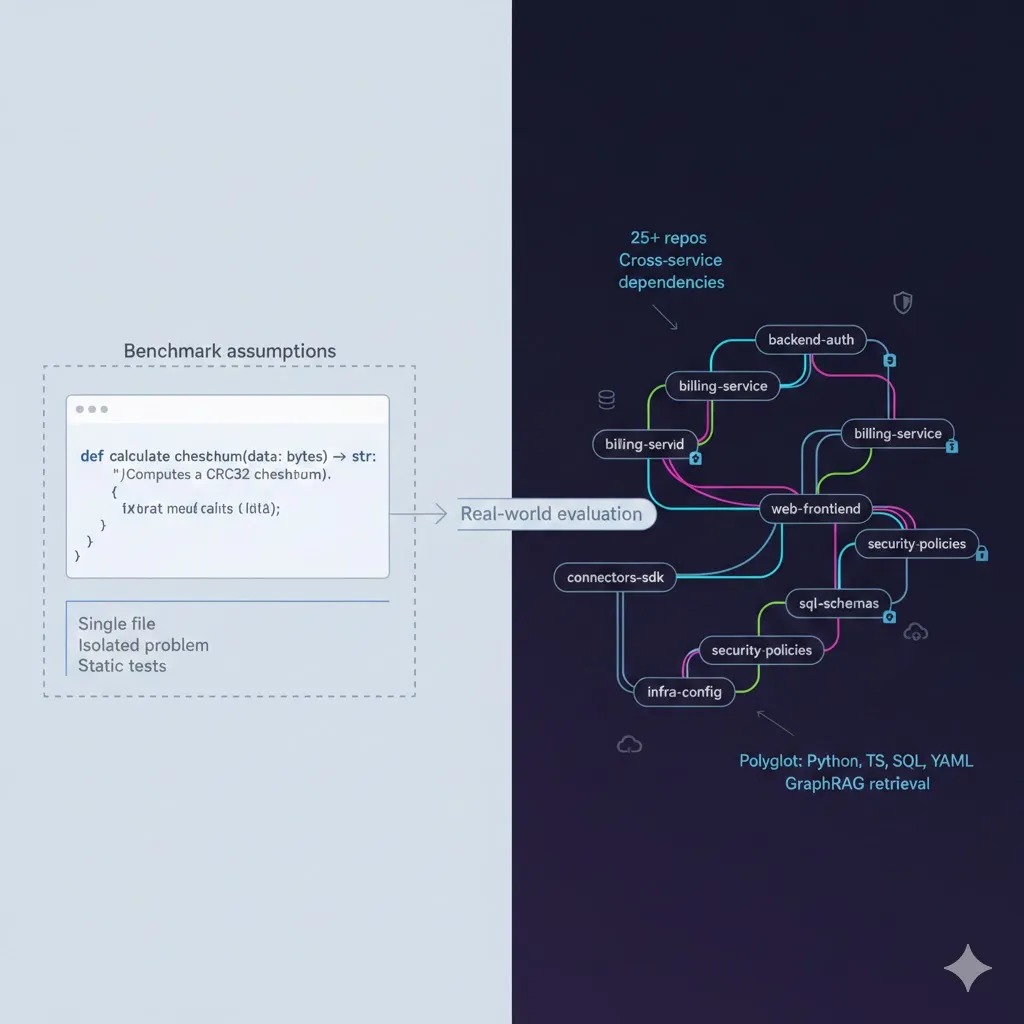
The Code Context Landscape — Every Major Approach Compared to ByteBell
A comprehensive map of open-source tools providing context to AI coding agents, grouped by their underlying technical approach, with a direct analysis of how each compares to ByteBell.
Before We Compare Anything — What ByteBell Is Not
The AI coding tooling space is crowded enough that every new entrant claims to do everything. We want to be clear upfront about what ByteBell is not, so the rest of this comparison is read as a fair-minded map of a real ecosystem rather than a sales document.
- ❌ Not an IDE. ByteBell does not replace Cursor, VS Code, JetBrains, or any other editor. It provides context to the AI assistants running inside them.
- ❌ Not an autocomplete tool. ByteBell does not generate code completions. It makes the tools that do (Copilot, Cursor Tab, Claude Code) dramatically smarter by giving them the right context.
- ❌ Not a symbolic editor or refactoring tool. If you want atomic rename, move, or inline operations, Serena does this better than we ever will — and we recommend running it alongside ByteBell.
- ❌ Not a code review bot. ByteBell can power one (and several teams use it that way), but it is not Greptile, CodeRabbit, or Qodo.
- ❌ Not yet-another vector DB wrapper. Vector similarity is one signal we use; it is not the architecture. Tools like
claude-contextdo pure vector search well and are the right choice for many smaller use cases. - ❌ Not the right tool for a 10-file repo. For small single-repo projects, brute-force file reading or a lightweight tool like Aider’s repo map is genuinely sufficient. ByteBell is overkill.
- ❌ Not the only graph in town. We did not invent code knowledge graphs. Sourcegraph, Codebase-Memory, code-graph-mcp, and many others have built graphs before us, and several do specific things better than we do.
What ByteBell is: infrastructure for one specific shape of problem — organization-wide, cross-repository code intelligence with on-prem data sovereignty, served to AI coding agents via MCP. Outside that shape, the lighter and more specialized tools surveyed below are often the better answer. Inside that shape, we believe ByteBell is currently the only option built for exactly this need at mid-market pricing.
The rest of this document maps the ecosystem honestly so you can pick the right tool for your situation — which may or may not be us.
The Four Architectural Camps
Every tool in this space falls into one of four buckets based on how it extracts and serves context:
| Camp | What it captures | Strength | Fundamental Limit |
|---|---|---|---|
| Vector / Semantic | ”What code looks like other code” | Fast similarity search across millions of chunks | Doesn’t know what code does or why it exists |
| AST / Structural | ”Who calls what” — symbols, imports, call graphs | Precise, deterministic, language-aware | Tells you the wiring but not the purpose |
| Compiler-Indexer (SCIP/LSP) | Type-precise symbol resolution | Compiler-grade accuracy | Requires per-language indexers; heavy setup |
| LLM-Generated Metadata | ”What this file is for, who owns it, what business problem it solves” | Semantic understanding that mirrors how engineers think | Indexing cost is non-trivial (mitigated by diff-aware re-indexing and model selection) |
ByteBell sits in the fourth camp — and combines it with structural edges and cross-repo semantic links on every node.
Camp 1: Vector / Semantic Embedding Tools
These chunk code, embed each chunk into a vector database, and retrieve via cosine similarity (often hybrid with BM25 keyword search).
1. claude-context (Zilliz)
- Repo: github.com/zilliztech/claude-context — ~7.5K stars, hit #1 GitHub trending
- How it works: Chunks code with Tree-sitter AST-aware splitter, embeds with OpenAI/VoyageAI/Ollama/Gemini, stores in Milvus/Zilliz Cloud, serves via MCP. Hybrid search = BM25 + dense vector.
- Claim: ~40% token reduction vs brute-force file reading.
- Limits: Requires external vector DB account and embedding API. Embeddings tell you what looks like what you searched for — not what the code does or why it exists. No relationship graph, no business context, no cross-repo intelligence by default.
- vs ByteBell: claude-context is the most popular tool in this category and the easiest to set up. But it’s pure semantic similarity. ByteBell stores semantic meaning (LLM-generated
purpose,summary,businessContext) alongside structural edges — so a query like “Where do we validate refunds?” returns the right file even if the function is namedprocessChargeback()and lives in a different repo.
2. Augment Context Engine
- Type: Closed-source SaaS, but exposes MCP. Backed by $252M funding.
- How it works: Semantic indexer with claimed cross-repo support. “Context Lineage” tracks commit history.
- Limits: Cross-repo mode routes through Augment’s cloud — dealbreaker for regulated industries. Indexing is heavier, tied to their product ecosystem.
- vs ByteBell: Closest commercial competitor by claim. ByteBell wins on data sovereignty (on-prem default), being infrastructure-first rather than a feature of an AI assistant, and mid-market pricing.
Camp 2: AST / Tree-Sitter Structural Tools
These parse code into ASTs, extract symbols and call edges, and serve structural queries (who calls X, who imports Y).
3. Serena (oraios) — 24.2K stars, the heavyweight in this camp
Repo: github.com/oraios/serena (MIT, v1.3.0 May 2026, 1.6K forks)
Tagline: “The IDE for your coding agent”
How it works: Serena is not a graph or an embedding index — it is a symbolic IDE-toolkit exposed via MCP. Two interchangeable backends power it:
- Language Servers (LSP) — the default open-source path, supporting 40+ languages including Python, TypeScript, Go, Rust, Java, C/C++, C#, Kotlin, Swift, Ruby, PHP, Elixir, Haskell, Scala, Solidity, Zig, Lean 4, and more.
- JetBrains Plugin (paid, free trial) — leverages the JetBrains IDE’s own analyzer for IntelliJ, PyCharm, GoLand, WebStorm, etc. Adds capabilities LSP can’t match: type hierarchy, move/inline refactoring, propagated deletions, and interactive debugging with breakpoints + REPL.
Tool surface:
- Retrieval —
find_symbol,find_referencing_symbols, file outline, find declaration/implementations, query external projects, diagnostics - Refactoring — rename symbols (LSP) or rename/move/inline symbols + files + directories (JetBrains)
- Symbolic editing —
replace_symbol_body,insert_after_symbol,insert_before_symbol,safe_delete(far more token-efficient than diffs over line numbers) - Memory system — lightweight persistent notes across sessions, complementary to
AGENTS.md/CLAUDE.md - Basic utilities — regex search, file ops, shell commands (usually disabled when running inside Claude Code / Codex which already provide these)
- Retrieval —
Why agents love it: In Serena’s own evaluations (Opus 4.6 on Python, GPT-5.4 on Java and on a multi-language monorepo), agents independently concluded that cross-file renames, references, and refactors that would otherwise take 8–12 careful tool calls collapse into one atomic, semantics-aware call. Less fragile text surgery, fewer “almost correct” edits.
Strengths: IDE-grade precision. 40+ language coverage is the broadest LSP-based MCP available. The agent-first tool design (symbol-level, not line-number-level) is genuinely different — most other tools force the LLM to operate on line ranges, which is error-prone.
Limits:
- Symbol-level only. Serena knows
validateRefund()exists inpayments/service.pyand that 14 things reference it. It does not know why that function exists, what business problem it solves, what product flow it belongs to, or how it relates to the Stripe integration in a sister repo. - Per-project scope. Serena is project-based. Cross-repo intelligence across an organization isn’t its model — each project is configured and indexed independently.
- LSP setup overhead per language. Strong languages (Python, TS, Go, Rust, Java) work out of the box; long-tail languages may need additional LSP server install.
- No persistent graph artifact. Serena queries the LSP at runtime — there’s no pre-computed graph you can hand to a different tool or query at scale across many repos at once.
- Symbol-level only. Serena knows
vs ByteBell — the honest comparison:
Serena and ByteBell solve different problems in the same workflow and are largely complementary rather than competitive.
Dimension Serena ByteBell What it captures Symbols, types, references, refactor operations File purpose, business context, cross-repo relationships, commit history Granularity Function / class / symbol File / module / repo Scope Per project Organization-wide, cross-repo Engine LSP or JetBrains IDE LLM-generated metadata + AST + cross-repo edges Best at ”Rename validateRefundeverywhere it’s used and update the type signature""Where is refund logic across our 47 microservices and what will break if I change the schema?” Setup Per-project init via serena initPer-org indexing; diff-aware re-indexing on commit Token efficiency win Atomic symbol ops vs multi-step text edits Pre-computed graph vs brute-force file reads On-prem ✅ Yes (LSP runs locally) ✅ Default architecture The clean way to think about it: Serena gives your agent IDE-level reflexes — the kind of precise symbol surgery a senior engineer using PyCharm can do in two clicks. ByteBell gives your agent architectural awareness — the kind of cross-repo, business-context knowledge a tech lead carries in their head about how 50 repos fit together.
A team that runs Serena + ByteBell side-by-side gets both: precise edits and informed decisions about where to make them. We do not view Serena as a competitor — we view it as the best symbolic editing layer to pair with our context graph. If we had to pick one positioning sentence: Serena makes the agent a better editor; ByteBell makes it a better architect.
4. code-graph-mcp (sdsrss)
- Repo: github.com/sdsrss/code-graph-mcp
- How it works: Rust + SQLite. Tree-sitter AST extraction for 16 languages. Stores call graphs in SQLite with FTS5 + sqlite-vec for hybrid BM25 + vector search via Reciprocal Rank Fusion. Optional local Candle embeddings.
- Features: Call graph traversal, HTTP route tracing, dead code detection, BLAKE3 Merkle tree for incremental indexing.
- vs ByteBell: Excellent single-repo structural understanding. No business-context layer, no cross-repo graph spanning microservices. Each node stores symbol metadata; ByteBell nodes store
purpose,summary,businessContext, classes, functions, keywords, internal + external imports, and per-commit history.
5. Codebase-Memory (academic, arXiv 2603.27277)
- How it works: Tree-Sitter graph across 66 languages, exposed via MCP with 14 typed tools. Single statically-linked C binary.
- Benchmark: 83% answer quality vs 92% for file-exploration agent, at 10× fewer tokens and 2.1× fewer tool calls.
- vs ByteBell: Strong pure-structural baseline with academic rigor. Same gap as the others: structure but no purpose. ByteBell adds the semantic layer that explains why the structure exists.
6. mcp-server-tree-sitter (wrale)
- Repo: github.com/wrale/mcp-server-tree-sitter
- How it works: General Tree-sitter MCP server — exposes AST queries, pattern search, structure-aware traversal across many languages.
- vs ByteBell: A toolkit, not an indexed graph. Agent has to run queries to discover structure each time. ByteBell pre-computes the graph once and serves precomputed answers.
7. jcodemunch-mcp
- Repo: github.com/jgravelle/jcodemunch-mcp
- How it works: Tree-sitter symbol indexing + BM25 + opt-in semantic search. Features: PageRank symbol importance, dead code detection, git-diff-to-symbol mapping, cross-repo API contract surfacing.
- vs ByteBell: One of the more featureful AST-based MCPs. Still symbol-centric — ByteBell’s per-file LLM analysis captures meaning that pure AST parsing cannot.
8. graphify (safishamsi)
- Repo: github.com/safishamsi/graphify
- How it works: AST via Tree-sitter for 25 languages + Leiden community detection for clustering. Multi-modal — also processes PDFs, images, videos (via Whisper), markdown into one graph. Runs locally; code never leaves the machine.
- Strength: The clustering and multi-modal angle is unique.
- vs ByteBell: Skill-based (runs inside Claude Code / Cursor / etc.), not a persistent server. ByteBell is server infrastructure designed to be queried by many agents simultaneously across an org.
9. GitNexus
- How it works: Zero-server AST in LadybugDB. Static call/import graph.
- vs ByteBell: Lightweight and dependency-free, but a thin AST graph. ByteBell layers business meaning, cross-repo links, and commit history on top.
10. code-review-graph
- How it works: AST + call edges, scoped to single repos for code review use cases.
- vs ByteBell: Single-repo focus. ByteBell is built for cross-repo from day one.
11. Aider's Repo Map
- Repo: github.com/Aider-AI/aider — built into Aider, ~30K stars
- How it works: PageRank-style graph over file dependencies. Selects the most-referenced symbols to fit the active token budget, sends only the map to the LLM.
- vs ByteBell: Lives inside Aider, not a standalone MCP. Optimizes a single session’s context — no persistent graph, no cross-repo, no business context.
Camp 3: Compiler-Level / SCIP Indexers
These use language-specific indexers to extract type-precise symbol information.
12. Sourcegraph + Cody (SCIP)
- How it works: SCIP (Source Code Intelligence Protocol) per-language indexers extract compiler-grade symbols, types, and references. Backed by a sophisticated search engine.
- Strength: Most architecturally similar to what ByteBell builds, just from a different angle. Compiler-precise navigation.
- Limits: Per-language SCIP indexers (significant setup cost). Cody Free/Pro discontinued July 2025 — Enterprise-only at $59+/user/month. Strategic focus split between Cody, Amp, and Code Search.
- vs ByteBell: Sourcegraph captures “function X in repo A calls function Y in repo B” (structural intelligence). ByteBell captures “this file handles payment validation and connects to the Stripe service” (semantic intelligence). Sourcegraph is enterprise-only; ByteBell serves the mid-market (5–200 devs). ByteBell’s LLM-metadata approach is language-agnostic — works on any language the model can read, no per-language indexer needed.
13. CodeGraphContext
- How it works: Multi-backend Neo4j / LadybugDB / FalkorDB. Structural code graph.
- vs ByteBell: Heavy infrastructure footprint. ByteBell ships with a default backend and adds the business-context layer.
14. code-grapher
- How it works: Neo4j-based code graph with optional LLM pass for enrichment.
- vs ByteBell: The LLM pass is optional in code-grapher; in ByteBell, the LLM analysis is the core of the architecture — every node is enriched with LLM-generated meaning, not just structure.
Camp 4: LLM-Generated Metadata Tools (ByteBell’s Camp)
15. ByteBell (the reference architecture)
- Repo: github.com/ByteBell/bytebell-oss
- How it works: Per-file LLM analysis at index time. Each node stores
purpose,summary,businessContext, classes, functions, keywords, internal imports, external imports, and per-commit history. Diff-aware re-indexing (only changed files cost LLM tokens). - Cost economics: Indexing a 200K file monorepo costs ~$150 at DeepSeek V4 Flash pricing. Ongoing cost is proportional to commit churn, not repo size — a typical commit changing 12 files costs 12 LLM calls.
- Performance: 80% lower token cost vs brute-force; 10%+ accuracy lift over SOTA models on cross-repo queries.
- Deployment: On-prem first. Code never leaves customer infrastructure.
16. Understand-Anything
- How it works: Multi-agent extracted graph — uses LLM agents to build a knowledge graph from code.
- vs ByteBell: Similar philosophy, less mature/focused. ByteBell’s diff-aware indexing and structured node schema is the production-grade version.
17. Deep Graph MCP (CodeGPT)
- How it works: Hosted version of the CodeGPT approach — semantic + structural graph as a service.
- vs ByteBell: Hosted only. ByteBell offers on-prem deployment for the regulated industries Deep Graph cannot serve.
Camp 5: Adjacent — Memory Layers (not code-specific)
These solve “AI memory” for conversations/documents but are sometimes confused with code context:
- Mem0 — conversational memory for agents (remembers users, not code)
- Letta (MemGPT) — OS-style tiered memory with self-paging
- Cognee — knowledge engine; has a code-graph pipeline as one feature
- Graphiti / Zep — temporal knowledge graphs with validity windows
- SuperMemory — RAG memory for general AI apps
None of these are code-context-first. They become relevant when you want your AI assistant to remember user preferences alongside code context — ByteBell handles the code half, Mem0/Letta handle the user half.
Direct Comparison Matrix
| Tool | Approach | Cross-Repo | On-Prem | Business Context | MCP | Cost Reduction Claim |
|---|---|---|---|---|---|---|
| ByteBell | LLM metadata + AST + cross-repo edges | ✅ Native | ✅ Default | ✅ Per-node | ✅ | 80% |
| claude-context | Vector embeddings | ❌ | ⚠️ (needs Milvus) | ❌ | ✅ | 40% |
| Augment Context Engine | Semantic indexer (closed) | ✅ via cloud | ❌ Routes via cloud | ⚠️ Limited | ✅ | 30–80% |
| Serena (24.2K ⭐) | LSP or JetBrains, symbol-level, 40+ langs | ❌ Per-project | ✅ | ❌ (symbol only) | ✅ | High (atomic ops) |
| code-graph-mcp | Tree-sitter + SQLite + hybrid | ❌ | ✅ | ❌ | ✅ | Variable |
| Codebase-Memory | Tree-sitter graph (66 lang) | ❌ | ✅ | ❌ | ✅ | 10× tokens |
| graphify | AST + Leiden + multimodal | ❌ | ✅ | ⚠️ Cluster labels | ✅ | Variable |
| Aider Repo Map | PageRank over deps | ❌ | ✅ | ❌ | ❌ (in-tool) | Session-only |
| Sourcegraph SCIP | Compiler indexer | ✅ Enterprise | ⚠️ Heavy setup | ❌ | ✅ Feb 2026 | Variable |
| jcodemunch-mcp | Tree-sitter + BM25 + opt-in vector | ⚠️ Partial | ✅ | ❌ | ✅ | Variable |
| CodeGraphContext | Neo4j structural | ❌ | ⚠️ | ❌ | ✅ | Variable |
| code-grapher | Neo4j + optional LLM | ⚠️ | ✅ | ⚠️ Optional | ✅ | Variable |
ByteBell’s Honest Positioning
ByteBell didn’t invent code knowledge graphs. What it invented is the combination:
- Business context on every node (LLM-generated
purpose,summary,businessContext) - Structural edges (AST-derived call/import relationships)
- Cross-repo semantic links (the same concept connected across microservices)
- Per-commit history (how each file evolved, baked into the graph)
That combination is what cuts AI coding token bills by 80%+ — not any single piece in isolation. Embeddings tell you what code looks like. AST parsers tell you who calls what. ByteBell tells you what the code is for.
Where each camp wins
- Pure vector search (claude-context) wins when you need cheap, fast similarity over a single repo and your queries are well-phrased to match the actual code.
- Symbolic IDE-toolkit (Serena) wins when your agent needs to edit code — rename, refactor, move symbols, find references. The atomic symbol-level operations are dramatically more reliable than text surgery over line ranges. The natural pairing for any context graph (including ByteBell).
- Pure AST graphs (code-graph-mcp, Codebase-Memory) win when you need symbol-level retrieval — “find every caller of
validateRefund” — and your codebase fits in one repo, but you don’t need the editing operations Serena provides. - SCIP (Sourcegraph) wins when you have enterprise budget and need compiler-grade accuracy with mature tooling.
- ByteBell wins when you need to answer “how does billing work across our 47 microservices, and what will break if I change the refund schema?” — the cross-repo, semantic, on-prem-first question that nobody else covers at mid-market pricing.
The Decision Rule
If your codebase is small and single-repo → claude-context for retrieval, Serena for editing. If you need symbol-level precision and refactoring in one repo → Serena is the gold standard (24.2K stars for a reason). If you need a structural graph without the editing layer → code-graph-mcp or Codebase-Memory. If you’re an enterprise with budget and patience → Sourcegraph. If you have 10+ repos, regulated data, and need semantic cross-repo intelligence → ByteBell is the only option built for exactly this shape — and pairs naturally with Serena for editing.
Closing Thought
The code context space is moving fast. As of mid-2026, MCP has emerged as the universal protocol; LLM-generated metadata is becoming a credible alternative to brittle compiler indexers; and the line between “memory layer,” “code graph,” and “symbolic toolkit” is being drawn more clearly by tools that pick one and do it well rather than claiming to do all three.
We built ByteBell because, after surveying everything in this document, we still couldn’t find a tool that gave a 50-developer team with 20+ private repos and regulated data the context they needed without sending code through someone else’s servers. If you’re in that shape, we’d love to talk. If you’re not, we hope this map helps you pick the right tool above.
The references in this comparison are not adversaries — most of them are run by engineers we respect, and several of them are tools we use and recommend. Code context is hard. The more good tools exist for it, the better off every developer is.