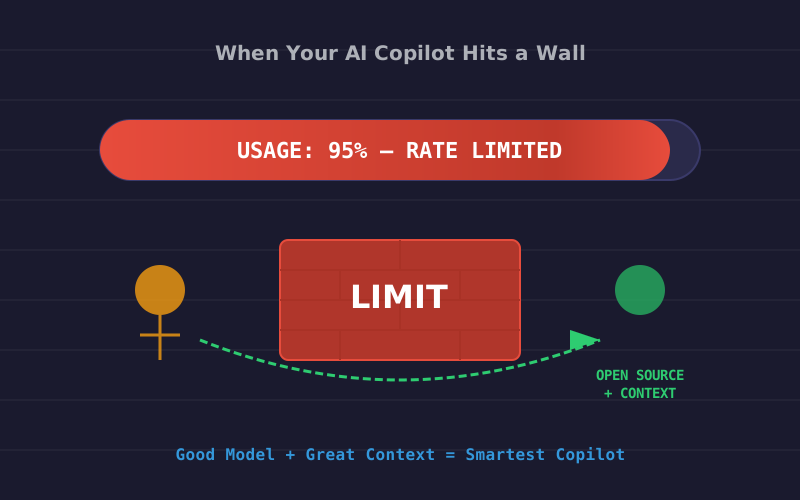
Claude Is Rate-Limiting Everyone. Here’s Why Good Context Beats a Smarter Model.
What Happened This Week
If you use Claude for coding, you already know. If you don’t — here’s the short version:
On March 26, 2026, Anthropic quietly tightened usage limits for Claude Free, Pro, and Max subscribers during peak hours (weekdays 5 AM–11 AM Pacific). Sessions that used to last several hours started dying in 90 minutes. Max subscribers — paying up to $200/month — watched their usage meters jump from 21% to 100% on a single prompt.
The community reaction was immediate and brutal:
- “Out of 30 days I get to use Claude 12.” — Claude Pro subscriber
- “Used up Max 5 in 1 hour of working. Before I could work 8 hours.” — Developer on Reddit
- “This felt like a rug pull.” — Brad Groux on X
- Multiple users reported canceling their subscriptions within days
Anthropic’s CEO Thariq Shihipar eventually confirmed the change: peak-hour session limits drain faster, though weekly totals remain “unchanged.” But for developers who need their copilot during working hours — which is when most coding happens — the weekly total is irrelevant if you can’t use it when you need it.
The Deeper Problem: Model Lock-In
This isn’t just about one bad week. It’s about a structural dependency that most development teams have sleepwalked into.
Here’s how it usually goes:
- You start using Claude (or GPT, or Gemini) for coding
- Your workflow depends on it — code reviews, refactoring, debugging, test generation
- The provider changes pricing, adjusts limits, or has an outage
- You’re stuck. Your productivity craters. You have no fallback
This is model lock-in, and it’s the vendor lock-in of the AI era. When Anthropic throttles Opus during your working hours, you don’t have a Plan B. Your entire coding workflow stops.
And it’s getting worse. Opus 4.6 reportedly consumes quota at 3–5x the rate of previous versions for identical workloads. The model got better, but the cost of using it grew even faster.
The Equation Everyone Gets Wrong
The industry has convinced developers of a simple (and wrong) formula:
This is false. The actual equation is:
A frontier model with bad context produces hallucinations. A frontier model with no access (because you’re rate-limited) produces nothing. But a good model with excellent context produces results that rival — and in many cases exceed — a frontier model fumbling through your codebase blind.
Let’s make this concrete.
What Happens When Claude Reads Your Code
When you ask Claude Code to refactor your authentication middleware, here’s what actually happens behind the scenes:
Step 1: grep for auth-related files         →  4,200 tokens
Step 2: Read auth.ts                        →  3,800 tokens
Step 3: Read middleware.ts                   →  2,100 tokens
Step 4: Read auth.test.ts                   →  5,200 tokens
Step 5: Read routes.ts                      →  3,400 tokens
Step 6: Read userModel.ts                   →  4,300 tokens
─────────────────────────────────────────────────────
Total context consumed just reading code:     23,000 tokens
Context remaining for actual reasoning:       77,000 tokens (of 200K)
Now ask a follow-up question. More files get read. Ask another. More tokens burned. By your third question, 52% of the context window is occupied by raw file contents, leaving barely enough room for the model to reason about your problem.
And every one of those tokens counts against your rate limit.
This is why Opus 4.6 drains quota 3–5x faster — it’s not just that the model is more expensive per token. It’s that agentic workflows (Claude Code, Cursor, etc.) read 40–60 files per session to understand your codebase. Each session burns through your allocation at an alarming rate.
The Alternative: Good Model + Great Context
Here’s the argument we want you to seriously consider:
A “good model” in 2026 doesn’t mean mediocre. Open-source models have reached a point where the gap with frontier models is narrow and shrinking:
| Model | Parameters | Code Performance (HumanEval+) | Cost per 1M Tokens | Rate Limits |
|---|---|---|---|---|
| Claude Opus 4.6 | Unknown | ~94% | 75 (output) | Yes — throttled during peak hours |
| Claude Sonnet 4.5 | Unknown | ~90% | 15 | Yes — throttled during peak hours |
| Qwen3-Coder 32B | 32B | ~87% | 0.50 (self-hosted) | None |
| DeepSeek V3 | 671B MoE | ~89% | 1.10 | Generous |
| Llama 4 Maverick | 400B MoE | ~86% | Free (self-hosted) | None |
The gap between Opus at 94% and Qwen3-Coder at 87% sounds meaningful — until you realize that context quality is the dominant variable, not model quality.
A Real Example
Consider two setups debugging a cross-service API failure:
Setup A: Claude Opus + Raw File Reading
- Model reads 12 files across 3 repos
- Burns 45,000 tokens on file contents
- Misses the shared protobuf definition in repo #4 (never read it)
- Hallucinates a fix based on incomplete understanding
- You hit your rate limit before finishing the task
Setup B: Qwen3-Coder 32B + Private Code Context
- Knowledge graph already has all 4 repos indexed
- Serves precisely the relevant function signatures, dependencies, and protobuf definitions
- Uses 1,400 tokens of context (3% of window)
- Model uses remaining 97% of context for reasoning
- Produces correct fix with source citations
- No rate limit. No throttling. No surprise bills.
Setup B wins. Not because Qwen3-Coder is a better model — it isn’t. But because the context it received was 20x more relevant and 30x more efficient.
Why Context Is the Multiplier
Think of it this way. A model’s raw capability is like an engine’s horsepower. Context is the fuel quality and road conditions.
A 500-horsepower engine (Opus 4.6) on a dirt road with bad fuel (raw file reads, bloated context, rate-limited mid-task) loses to a 350-horsepower engine (Qwen3-Coder) on a paved highway with premium fuel (precisely scoped, graph-structured context).
The math backs this up. From attention research:
Where is the number of tokens in context and is the number of relevant tokens. When you stuff 45,000 tokens but only 1,400 are relevant, attention dilution reduces effective accuracy by roughly 35–40%. A 94%-capable model operating at 60% of its capacity scores ~56%. A 87%-capable model operating at 95% of its capacity scores ~83%.
The model with better context wins by a wide margin.
What Private Code Context Actually Does
This is where ByteBell’s Private Code Context changes the game — and it works with any model, including open-source ones you self-host.
Instead of reading files on every session:
- Persistent Knowledge Graph — Your codebase is pre-indexed into a structured graph that understands relationships between functions, services, types, and dependencies across all your repositories
- Surgical Context Delivery — When you ask a question, the graph serves only the relevant nodes — not entire files, not raw grep results, but precisely the context the model needs
- 3% Context Usage — Where raw file reading consumes 50–80% of the context window, Private Code Context uses ~3%, leaving 97% for the model to actually think
- Zero Token Waste on Re-Reading — The graph persists across sessions. No more burning tokens re-reading the same files every conversation
The result:
| Metric | Raw File Reading (Claude Code) | Private Code Context + Any Model |
|---|---|---|
| Context consumed by code | 50–80% | ~3% |
| Tokens wasted per session | 150,000–200,000+ | Near zero |
| Cost per query | 6.00 | 0.15 |
| Rate limit risk | High (peak hours throttled) | None (self-hosted models) |
| Cross-repo awareness | No (reads one repo) | Yes (full dependency graph) |
| Accuracy on cross-repo tasks | ~55% (attention diluted) | ~85% (context precisely scoped) |
The Freedom to Choose Your Model
Here’s what changes when context quality is decoupled from the model:
You’re no longer locked into one provider. If Anthropic throttles Claude tomorrow, you switch to DeepSeek. If OpenAI raises prices, you switch to Qwen. If you need air-gapped security, you run Llama locally. The context layer stays the same.
You can match the model to the task. Use a fast 8B model for simple completions. Use a 32B model for complex refactoring. Use a frontier API model when you need maximum capability. Private Code Context works with all of them through MCP (Model Context Protocol) — the emerging universal standard for AI tool integration.
Your costs become predictable. No more surprise rate limits. No more “adjustments” during peak hours. No more paying $200/month and getting 12 usable days. Self-hosted models on your own GPU cost what your GPU costs. That’s it.
The Practical Setup
For teams that want to stop being at the mercy of API providers, here’s what a resilient AI coding setup looks like in 2026:
┌─────────────────────────────────────────┐
│           Your Development Environment   │
│                                          │
│  ┌──────────┐    ┌───────────────────┐  │
│  │ Any IDE  │◄──►│  MCP Client       │  │
│  │ (VSCode, │    │  (Claude Code,    │  │
│  │  Cursor, │    │   Cline, Aider,   │  │
│  │  Neovim) │    │   OpenCode)       │  │
│  └──────────┘    └────────┬──────────┘  │
│                           │              │
│                    ┌──────▼──────┐       │
│                    │  ByteBell   │       │
│                    │  Smart      │       │
│                    │  Context    │       │
│                    │  Refresh    │       │
│                    └──────┬──────┘       │
│                           │              │
│              ┌────────────┼────────────┐ │
│              ▼            ▼            ▼ │
│        ┌──────────┐ ┌──────────┐ ┌─────┐│
│        │ Qwen3    │ │ DeepSeek │ │Claude││
│        │ (local)  │ │ (API)    │ │(API) ││
│        └──────────┘ └──────────┘ └─────┘│
│                                          │
│  Your code never leaves your servers.    │
└─────────────────────────────────────────┘
The model is interchangeable. The context layer is the constant. When one model provider throttles you, you switch. Your knowledge graph, your codebase understanding, your cross-repo intelligence — none of that is lost.
The Bottom Line
Claude is a remarkable model. Opus 4.6 is genuinely the best coding model available today. But a model you can’t use when you need it is worth zero, no matter how good it is.
The March 2026 rate limiting incident isn’t an anomaly — it’s the new normal. As AI demand grows faster than GPU supply, every provider will face the same constraints. The question isn’t whether your favorite model will get throttled. It’s when.
The developers who thrive won’t be the ones chasing the smartest model. They’ll be the ones who built their workflow on great context that works with any model.
Because the smartest model in the world can’t help you when it’s rate-limited, out of context, or reading the wrong files. But a good model with the right context — delivered surgically, persisted across sessions, aware of your entire architecture — that’s a copilot that actually works. Every day. During peak hours. Without limits.
ByteBell’s Private Code Context works with Claude, GPT, Gemini, DeepSeek, Qwen, Llama, and any model that supports MCP. Your code never leaves your servers. See how it works →