The Diff Is the Wrong Unit of Review, and CodeRabbit Is Built on It
A pull request lands on a Tuesday afternoon. It changes 11 lines in a single file, the tests pass, and every automated reviewer in the pipeline approves it. Three weeks later a reporting service begins returning revenue numbers that are quietly wrong, and it takes 4 engineers 2 days to trace the problem back to those 11 lines.
Nothing about that diff was incorrect. The diff itself was entirely fine, and a careful human reading it in isolation would have approved it too. What was wrong lived in a different repository, owned by a different team, and no reviewer in the pipeline had ever read it.
This is the case where diff scoped review has nothing useful to contribute, and in a large engineering organisation it is now the majority of what actually breaks.
What CodeRabbit does, and does well
CodeRabbit is the most commercially successful product in the automated review category, and it has earned that position rather than bought it. The company closed a 84M, and it reached that scale by being genuinely useful at the thing it set out to do.
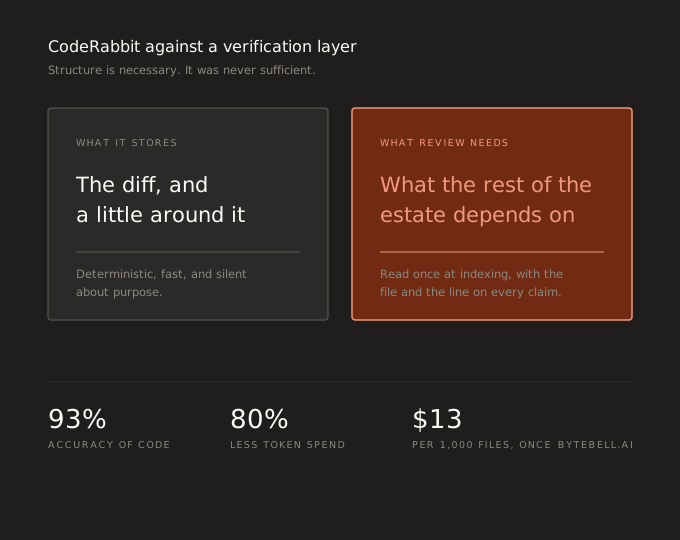
The architecture is straightforward and executed carefully. A pull request opens, CodeRabbit reads the diff, pulls a limited amount of surrounding file context, and runs a set of static analysis tools alongside a language model to produce line by line comments. It is fast, it covers a very large number of languages, and it is unfailingly polite about all of it. For style, obvious logic errors, missing null checks and the entire class of mistake that lives inside the changed lines, it works.
The published independent testing numbers describe exactly what kind of tool this is. CodeRabbit reports a bug catch rate around 44% with roughly 2 false positives per run. That is a deliberately chosen trade rather than a shortfall. A reviewer that shouts constantly gets muted inside a week, so CodeRabbit chose precision over recall, and for a product scoped to the diff that is the correct engineering decision to have made.
Where the architecture runs out
The limitation has nothing to do with effort or model quality, and it would not be fixed by a better model. It is the unit of analysis.
A diff tells you what changed. It does not tell you what the changed code was promising to the rest of the system, because that promise is not written down anywhere in the repository you are looking at. It lives in the reporting service that reads the same payload, in the mobile client that decodes it strictly, in the billing job that assumed the field was never null, and in a decision somebody recorded in a review thread two years ago and then left.
Consider a concrete version. An agent adds a nullable field to a subscription model and stops counting cancelled subscriptions in monthly revenue. Inside the diff, that change is clean, idiomatic and well written. The difficulty is that the definition of an active subscription already lives in the billing package rather than the API layer, that the subscription shape is read by the reporting service as well, and that a mobile client decodes the same payload strictly, so an unknown field fails the parse there and nowhere else. Four files need to change, and the fourth is the one that nothing scoped to the diff will ever find.
There is a second problem, and it has grown considerably in the last year. Agents now write most of the code entering these pull requests. The volume of change went up by an order of magnitude while the number of people available to review it did not move at all. A reviewer catching 44% of bugs inside the diff is now filtering a stream that is 10 times larger and rather less trustworthy per line than the stream it was tuned against.
What a verification layer does instead
ByteBell is a verification layer generated on top of a codebase of any size below 10 million files, and the mechanism differs from review in a way that matters more than any feature comparison.
Cheap open source models read every file in every repository once, at indexing time. For each file, an agent works out what the code does, what it promises, which contracts it depends on, and which other files across every repository depend on it. All of that is written into one graph with a specification layer on top, in plain English, with the file and the line kept on every claim. Indexing 1,000 files costs about $13, and after that only what changes gets re-derived on each commit.
Review then stops being an analysis of a diff and becomes a comparison against a stored promise. The change is checked against what the file committed to at the indexed base, and against what every downstream consumer of that file already depends on. The question moves from whether this code is well written to whether this code still keeps the promises the rest of the organisation is relying on, which is a different question with a different answer.
On a traced run from our own product, tracing a change end to end across 32 impacted files in 4 repositories took 4 minutes 9 seconds and cost 30. A full test generation and review pass on a change came to 87,001 tokens at $0.11.
That is where the two headline figures come from: accuracy of code above 93%, and roughly 80% less token spend, arriving together rather than as a trade against each other.
Why both numbers move in the same direction
The usual assumption is that more accuracy means more tokens, and it is a reasonable assumption. It holds whenever the model has to work out what the code means at the moment you ask the question, because in that world accuracy is purchased by reading more files.
The layer breaks that relationship by moving the expensive reading to a place where it happens once. A model reading the layer skips the entire chain of establishing meaning before it can decide anything, which means it makes fewer dependent inferences and pulls in far less context. Fewer steps across less context is both cheaper and more accurate, and that is the whole reason a verification layer can decrease AI cost and raise correctness in the same pass.
Where CodeRabbit is genuinely the better answer
If your organisation runs a single repository, employs fewer than 30 engineers, and mostly wants a fast second pair of eyes on style and local logic, a diff scoped reviewer is simpler to adopt and will do that job well. Setup takes minutes, there is no indexing step, and nothing about the situation calls for more machinery than that.
We also do not compete for that seat in any real sense. CodeRabbit, Cursor and Copilot sit above the layer rather than against it, and any of them becomes more accurate when it reads a verified specification through MCP instead of guessing from whatever files it happened to reach.
The honest limitation
Indexing is a real step with a real cost. On a very large estate the first pass takes both time and money before you get anything back, and there is no version of this product where you connect a tool and see value in 90 seconds. We also do not support every language yet, and Mojo in particular is not indexed today.
If your problem is that a reviewer misses typos, this is a great deal more machinery than the situation requires. If your problem is that a clean pull request took down a service nobody thought to test, the diff was never going to be able to tell you.
This is what ByteBell builds
ByteBell is the verifiable context layer for code. We run the LLM compiler pattern, a one time pass where a model reads every file and lowers it into a verifiable code IR capturing purpose, business context and cross repository relationships, on your own infrastructure through Docker, with your source never leaving your environment. Every engineer, on any copilot, then queries the same representation through a single MCP url, and every agent edit is checked against it before it lands, using per file SHA-256 diffing so only what actually changed gets examined again. Across 46 Kubernetes ecosystem repositories and 150,000 files we measured roughly 10% higher accuracy at 70% lower cost, on about a fifth of the tokens.
You can index 1,000 files free and check whether the layer sees the dependency your last incident came through.